Competitor Backlink Prospecting: Find Relevant Referring Pages
By Jake9 min read
On this page
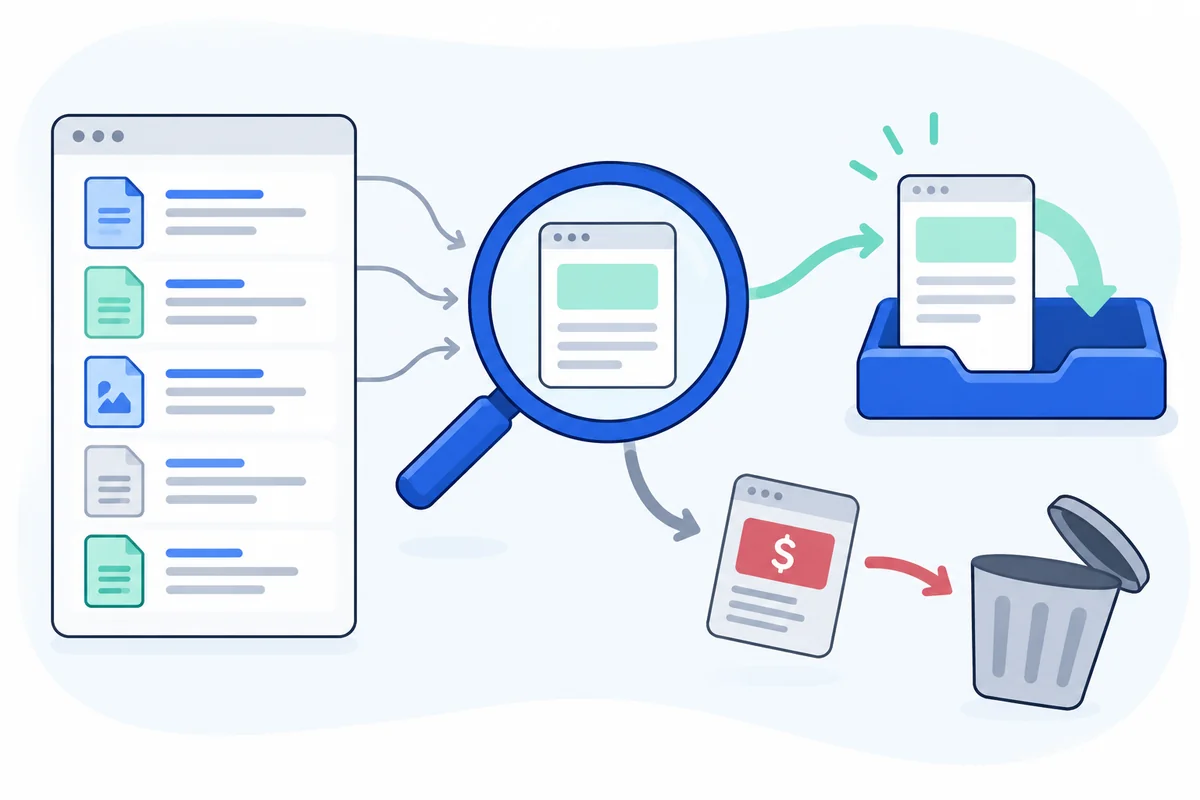
Competitor backlink prospecting uses another site’s referring pages to discover possible editorial opportunities. It tells you where to look, not where you are entitled to appear. Inspect the actual reference and decide whether your own resource adds something useful.
What you’ll learn
- Choose competitors by audience and reader task.
- Preserve provider dates and coverage limits.
- Qualify the referring page for your resource independently.
Choose page competitors before exporting links
Write the purpose of your asset in one sentence, then identify pages that serve that same purpose. For an MRR worksheet, useful comparison pages include other public calculation examples and founder finance tutorials. A broad software company may compete for customers while its homepage links reveal little about this particular resource.
Create a comparison sheet with the page URL, audience, task, resource format, and reason it belongs. Separate direct product competitors from content competitors. That distinction allows a tutorial publisher to be a useful discovery source without implying that it sells a competing product.
With a backlink provider, choose the scope deliberately. An exact-page report asks who refers to that resource. A whole-domain report can include unrelated press, careers, partnerships, and product lines. Preserve the provider name, report scope, retrieval date, and filters alongside the export. You need this information to interpret what the list actually represents.
Start small enough to inspect every referring page. If the initial comparison page produces mostly irrelevant relationships, switch the source. Increasing the export size does not fix a poor comparison choice. Without a provider, search for distinctive resource titles and inspect the references you find, while labeling that method as an incomplete discovery sample.
Write why each comparison page matters. A giant general-purpose brand can have a backlink profile dominated by jobs, partnerships, news, and unrelated products. That profile may contribute little to a narrow campaign.
Collect data with its limitations
When using a backlink provider, record the target, query scope, observation date, and filters. Referring pages, referring domains, new links, and lost links are different datasets. Keep those distinctions visible.
A provider’s database is not a complete record of every live reference. Missing data does not establish that a site has no links, and a listed link may have changed since the provider observed it.
Save the exact referring URL, linked destination, anchor, and surrounding context when available. Deduplicate carefully. Several links in one article should not become several pitches to the same editor.
If you do not have provider access, follow references in relevant articles and search for known resource names. This manual route is limited too; label it as discovery rather than a full backlink audit.
Inspect the editorial reason for the reference
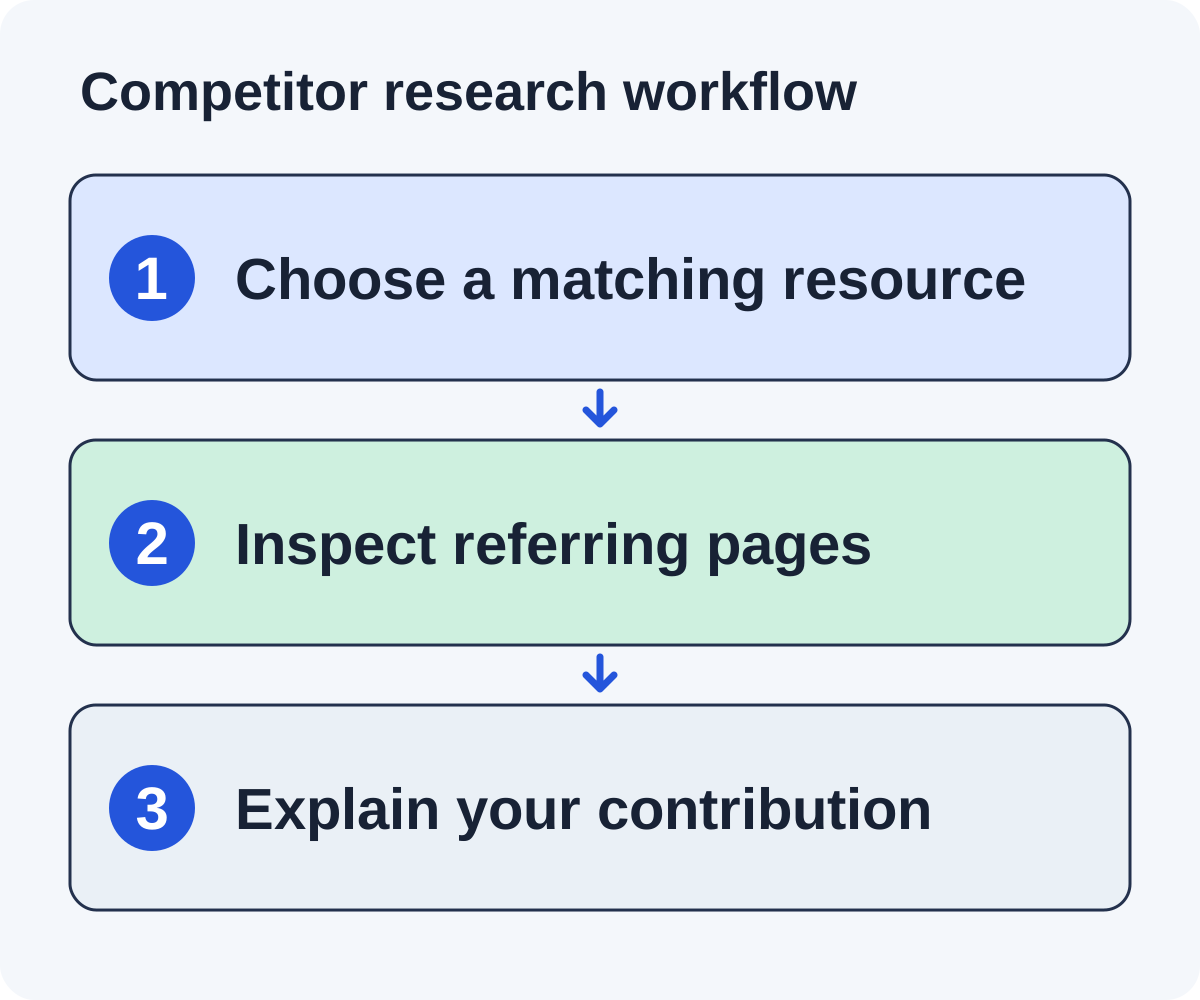
Open the page. Is the competitor cited for research, included in a product roundup, listed as a partner, quoted as an expert, or linked in an unrelated footer? Each reason has a different inclusion logic.
A relevant tutorial reference may be worth investigating. A customer logo or contractual partnership is not an open editorial slot. A product roundup can be useful only if your product meets its criteria.
Check whether the referring page already contains a resource equivalent to yours. Sometimes the competitor covers the reader task fully; sometimes your asset provides a distinct example. Describe that difference in terms the editor can verify.
Do not frame the pitch as a demand to remove the competitor. Ask for a useful addition or consideration that respects the publisher’s existing choices.
Turn a backlink export into an evidence ledger
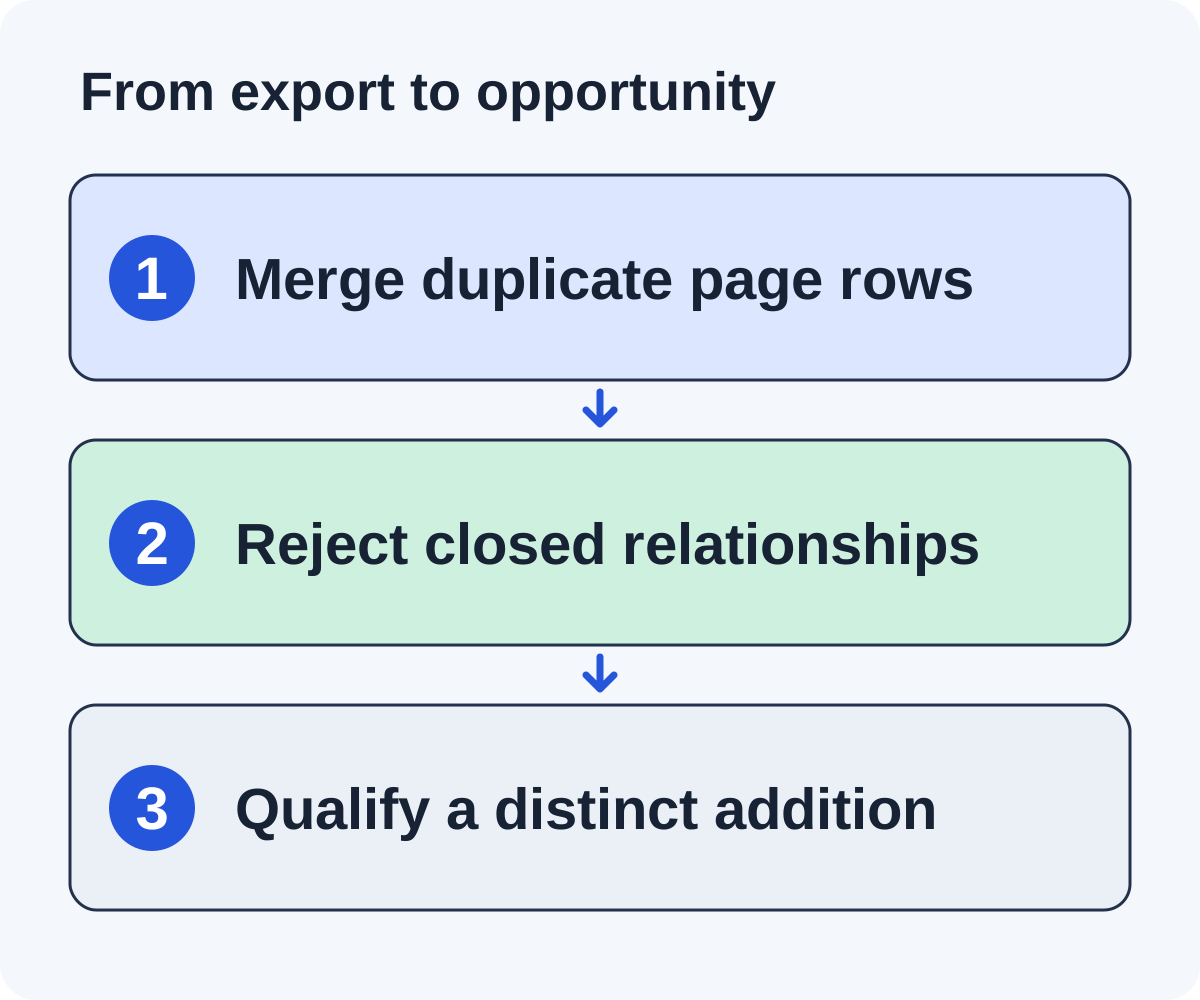
Imagine a fictional export containing 30 link rows from 18 referring pages across 12 publishers. Those are three different counts. Begin by normalizing obvious duplicate URLs, preserving distinct pages, and grouping publisher ownership for contact review. Do not send 30 messages merely because the file contains 30 rows.
Inspect the reference on each live page. A spreadsheet row showing an anchor is useful for navigation, but the current paragraph supplies the editorial reason. Record whether the competitor appears as a research source, product option, worksheet, partner, customer, or unrelated navigation link.
| Observed reference | What to preserve | Next step |
|---|---|---|
| Two anchors to one calculator in a tutorial | One page with both contexts | Assess whether your example adds a distinct task. |
| Three articles owned by one publication | Three page records, one publisher group | Choose a coordinated contact route. |
| A contractual integration partner listing | The relationship stated on the page | Reject if you have no equivalent eligibility. |
| A removed or inaccessible reference | Provider date and current observation | Investigate; do not claim a current opening. |
The ledger should retain rejected cases and the reason. Otherwise a teammate may rerun the export and restore them to the ready list. Keep “already covered” as a distinct reason when the page’s existing resource completely answers the reader task.
After qualification, save the difference your resource supplies. In this example, that might be a refund calculation absent from the basic calculator. If you cannot describe a checked difference, there is no sound basis for asking the editor to add another resource.
Work through a reference-to-prospect table
These examples are fictional and use a SaaS finance worksheet as the proposed asset.
| Competitor reference | Our decision | Reason |
|---|---|---|
| Tutorial cites a basic MRR calculator | Investigate | Our refund example may add a distinct calculation. |
| Partner page lists a contractual integration | Reject | No equivalent relationship or editorial inclusion reason. |
| Founder resource list includes several finance worksheets | Consider | The format and audience fit; duplication still needs checking. |
The referring domain alone would not show these differences. Keep page-level context as the deciding evidence.
A provider score can help order the accepted list, but it should not turn a partnership page into an editorial opportunity. Use the prospecting gates before writing.
Build an addition request without copying the competitor
The competitor led you to the page; it does not need to be the subject of the pitch. A publisher is deciding whether your contribution helps its article. Start with a short first email that asks whether the editor is open to a suggestion. After a yes, explain the relevant section and your distinct resource rather than saying that another company has a link and you should have one too.
Hi Avery, I read your recurring-revenue tutorial, including the annual-plan section. I’m with a team that makes SaaS finance tools. Would you be open to a link suggestion or a short guest post on subscription revenue? If so, I can send the details.
After Avery says yes, the reply carries the substance: the section gives a basic monthly calculation, your public worksheet adds a partial-refund example with visible formulas, it may help readers handle the adjustment, and it is at [checked URL].
These are fictional messages. They assume the described difference was verified on both resources. If the tutorial already covers refunds, revise the fit judgment instead of keeping the same sentence. A product comparison may require a category and eligibility check rather than a worksheet addition.
Keep your own resource’s limits visible. If it covers only one accounting convention, disclose that scope. Avoid “better,” “most accurate,” or “complete” unless you have evidence that supports the specific comparison and the claim matters to the editor.
Never present the competitor’s research, wording, diagrams, or relationships as your own. You can study the editorial reason for a reference and create an original contribution. A copied page with a different brand name does not supply a new reader benefit. Respect a publisher’s choice to retain the existing reference, include both resources, or decline yours.
Build the pitch from your own contribution
Save the page section, observed need, your asset’s contribution, contact evidence, and date checked. The competitor discovery route belongs in the research record; the editor usually needs the useful addition, not a report of your backlink analysis.
The first email only asks whether the editor is open to a suggestion. After a yes, a concise reply might describe the refund example your worksheet adds to a calculation section. Avoid asserting that your resource is superior unless you can support the comparison and the claim is relevant.
Track accepted, rejected, and uncertain candidates by discovery source. If a competitor’s references mostly fail fit checks, change the comparison set instead of expanding the same low-value export.
Use the worksheet to preserve scope and limitations. The output should be a qualified list your team can explain, not a copied collection of someone else’s links.
Choose a content competitor outside your product category
A fictional API monitoring product has a public migration checklist. A developer education site publishes a version-upgrade tutorial that solves a similar reader task, even though it sells no monitoring software. Its referring pages may therefore be more relevant discovery sources than a large direct competitor’s entire backlink profile.
Record why that tutorial belongs in the comparison set: the audience is integration developers, the task is managing an upgrade, and the format supplies practical steps. Inspect references to the exact tutorial where data is available, retaining scope and retrieval date.
Classify the referring contexts. An integration guide citing the tutorial for a missing rollback explanation may be relevant. A university syllabus may use it under course-specific selection rules. A homepage footer or partner announcement may offer no useful editorial context for your checklist.
For an accepted page, explain your own contribution without copying the tutorial. If your checklist supplies a checked rollback example that the existing reference omits, that difference may support an addition. If it duplicates the same complete workflow, there may be no reason to pitch.
Keep the discovery source in the research record. The message after a yes should explain the reader benefit, not suggest that the competitor’s presence entitles your product to appear.
Review rejection reasons by source. If a content competitor reveals relevant educational contexts, expand that research route cautiously. If the direct competitor’s export mostly contains commercial partnerships, change the comparison set rather than treating the larger list as better evidence.
Use rejection patterns to improve the next search
Review outcomes by comparison page and discovery method. If one source mostly produces partner listings, its value for an editorial worksheet campaign is low. If another supplies relevant tutorials but all already cover your exact task, the issue may be asset differentiation rather than discovery volume.
Track four practical bottlenecks: irrelevant audience, closed inclusion criteria, duplicate coverage, and unavailable evidence. Each suggests a different action. Change the comparison set for audience problems, skip closed relationship pages, improve or narrow the asset for duplication, and investigate inaccessible pages without pretending they are qualified.
A provider’s “lost link” record is also a lead to investigate, not proof that an editor wants a replacement. The article may have moved, the provider may have refreshed its crawl, or the reference may have been deliberately removed. Save current page evidence before deciding on outreach.
Should I target every domain that links to a competitor?
No. Domains contain many kinds of pages and relationships. Page context, inclusion criteria, and your contribution determine whether a request is useful. A competitor’s presence is a discovery clue, not eligibility.
Can I promise a similar result from copying their sources?
No. Their resource, timing, relationships, and publisher decisions differ from yours. Report the qualified opportunities you found and the references you actually verified. Keep search and referral observations separate from unsupported claims about the competitor’s success.
Put it to work
Use the companion worksheet to apply the decisions in this guide to your own campaign.
Download the worksheet (.txt)See what is worth pitching for your site.
Linkade finds relevant pages and writes pitches from their content. Add your domain and inspect prospects before choosing a paid plan.
Start free