MentionAgent Alternatives: Swap Mentions or Earn One-Way Links?
By Jake16 min read
On this page
MentionAgent is an AI agent that gets your site mentioned on blogs in your niche. Most of its deals are swaps: a blog adds a line about you, and you add a line about them to a post you’ve already published. It turns down sites that ask for a fee. That works well for some sites. If you want links that only run toward you, guest posts, or a place on sites that charge, you’ll need something else. This guide weighs seven MentionAgent alternatives against it. We read each vendor’s own site for prices and features on October 18, 2026.
Comparing just the two? Linkade vs MentionAgent puts them side by side on price, features and who each one suits.

What you’ll learn
- MentionAgent mostly trades mentions: the blog mentions you, and you mention it back.
- Decide which deal you’ll offer before you compare tools: a swap, a guest post or a link insert.
- Count what a swap costs you, including the link you give away and keep up.
- Stay with MentionAgent if you’re happy to link back and never want to pay a site.
What MentionAgent does
MentionAgent is an AI link building agent, started in 2026 in the Netherlands. You give it your site. It searches Google for blog posts on your subject, such as gift guides, review blogs, city and trade blogs and tool roundups. It checks each domain for authority and relevance, then finds and verifies the editor’s email address.
Each pitch is written about the editor’s post. MentionAgent registers a sending domain for you and sets up a Gmail inbox on it, so there’s no DNS work on your side. A new inbox starts at 5 emails a day and reaches 40 a day in its fourth week. Out of the box, each email needs your approval, given in the dashboard or through its Telegram bot. Auto-send is a setting you can switch on after warm-up begins.
When an editor replies, it drafts your answer and follows up if they go quiet. If they’re open to it, it proposes the page, the paragraph and the exact sentence to add. A nightly checker then lists which links are live, whether they’re followed, and which have gone. Twice a month it also puts your buyers’ questions to ChatGPT, Claude and Gemini and shows where the answers mention you.
The deal is the part to read closely. Its site says most deals are a mutual mention: the editor adds a line about you to one of their posts, and you add a line about them to a post you’ve already published. There’s no guest post to write and nothing to pay. MentionAgent doesn’t buy placements, and its agent turns down sites that ask for a fee. Some editors add you with nothing in return, though the sample pitch on its homepage offers a link back in the first email.
Who wrote this: Linkade, which appears among the seven options. Vendor facts come from each vendor’s own website as of October 18, 2026. We haven’t put every product through a hands-on test, so use the fit notes to shape your own trial, not as a verdict.
Decide which deal you want to offer
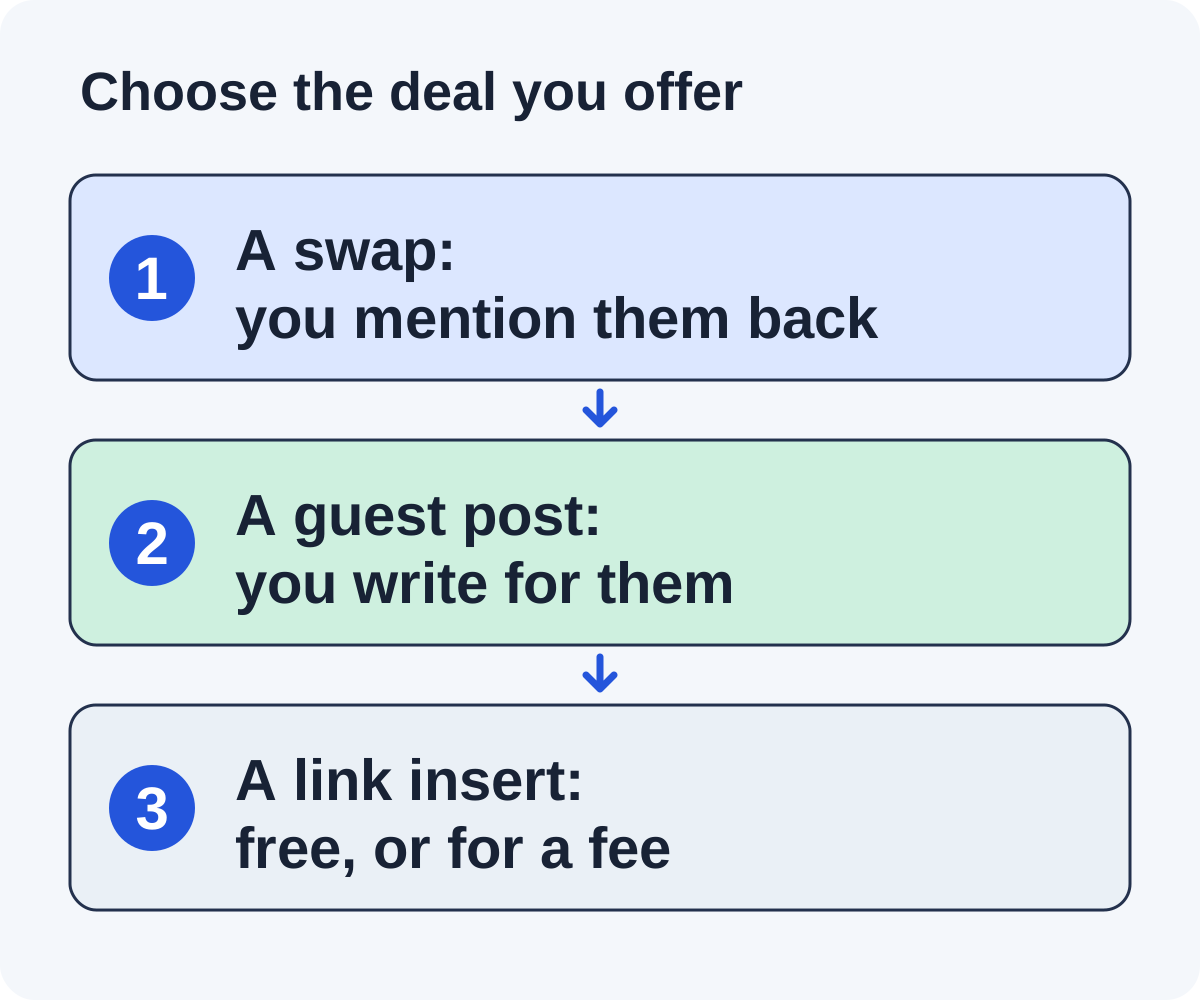
Every link from another site comes from a deal, even when no money changes hands. Before you compare tools, decide which of three deals you’re willing to offer, because most tools are built around one or two of them.
A swap. The editor mentions you, and you mention them back. It costs no money and almost no writing. What it does cost is a link out from your own pages that you agree to keep. Google’s spam policies list excessive link exchanges, “link to me and I’ll link to you,” as link spam. The word that matters there is excessive. An occasional mention between related sites is ordinary. A campaign that pays for every link with a link of its own is much closer to what the policy describes.
A guest post. You write an article for their site, and it links to you. It costs your time, and some sites charge a fee to publish it. Nothing is asked of your own site.
A link insert. The editor adds a link to you in a post they’ve already published. Some do it for free because the link helps their readers, and some charge. Again, your own pages stay as they are.
If you’re happy to link back and never want to pay a site, a swap is cheap and quick, and MentionAgent is built for it. If you’d rather keep your pages free of trades, or you’re ready to pay the sites that charge, look for a tool that pitches guest posts and link inserts. Our guide to unlinked brand mentions covers a fourth route: sites that already name you but don’t link.
Compare the alternatives at a glance
| Option | What the site is asked for | Price and main limit |
|---|---|---|
| Linkade Best for one-way links, including on sites that charge | A guest post or a link insert | Monthly plans, no contract. See pricing. Limit: you write the replies and any guest post. |
| Pitchbox Best for agencies running many campaigns | Whatever your team pitches | From $300 a month billed monthly, or $210 billed annually. Limit: one-year commitment, and your team runs it. |
| BuzzStream Best for teams that write their own pitches | Whatever your team pitches | From $49 a month. Limit: you find the sites and write every pitch. |
| Respona Best for buying finished placements | Nothing: its team arranges the link | $100 to $500 per placement. Limit: its team picks the sites unless you pay to approve them. |
| BacklinkGPT Best for founders promoting their own site | A free link, or a paid one within your budget | From $149 a month, plus any site fees. Limit: sends from your own inbox, and not built for agencies. |
| By hand Best for a first campaign | Any deal you choose | Your email account and your time. Limit: every step is yours. |
| An agency Best for handing off the whole job | Set by the agency | Usually a monthly retainer. Limit: you see less of the work. |
MentionAgent itself starts at $99 a month for one sending inbox, with no site fees. Those prices were read on October 18, 2026. Vendors change them often, so confirm on each pricing page before buying. Detail on every row follows.
Seven MentionAgent alternatives
1. Linkade
Linkade finds websites that suit your business and pitches each one for a guest post or a link insert. The deal runs one way: the site links to you, and Linkade never asks you to link back. It never pitches ad packages, sponsorships or memberships either.
It looks for sites in three places: who links to your competitors, which pages rank for your keywords, and who writes about your market. When one runs short, it widens the search. Every site is scored on its metrics and on how well it fits, and competitors, sites that have stopped publishing and sites outside your market are dropped. Sites that charge for a guest post or an insert stay on the list, and whether to pay is your call.
Before the first pitch, Linkade buys a separate domain for you, opens a mailbox on it and warms it for three weeks. From then on each mailbox sends at most 50 emails a day, spaced 5 to 7 minutes apart. Anyone who doesn’t answer gets one follow-up after 4 days, and the sequence ends when they reply. The opening email mentions a post or page the site has published and asks if they’d like to hear more. The link waits for a yes. You approve each email by default, and automatic sending is a switch only you can turn on. Linkade sorts the replies and you write each answer. Once a link is placed, Linkade looks at it every 24 hours and flags it as live, lost or changed.
Who it suits: founders and agencies after one-way links who are open to paying some sites. Plans run month to month and you can cancel whenever you like. See pricing. Setup is free and needs no card: in about 5 minutes it lists real sites it would contact for you. There’s no free trial after that.
The limits, next to MentionAgent: Linkade doesn’t draft your replies, and if a site wants a guest post, you write it. It has no check of what AI assistants say about you. Linkade is also new, launched in 2026, so there’s little history to judge it by. Compare the two in Linkade vs MentionAgent.
2. Pitchbox
Pitchbox is outreach software for agencies and in-house teams. It offers more than 20 ways to prospect, AI personalization, a link building CRM, reports and an AI Reply Agent that answers publishers. It pulls data from SEO tools you may already pay for, such as Ahrefs or Semrush, and has an API.
Pitchbox leaves the deal to you, so your team can pitch guest posts, inserts or swaps as it sees fit. You connect and warm your own mailboxes, and rotation between them starts on the second plan. The entry plan, Pro, is $300 a month on monthly billing or $210 on annual billing, with 2 users and 2 email accounts. The top plan, Scale, is $1,200 a month, or $825 billed annually. Free trials follow a demo.
The catch is a one-year commitment on every plan, and your team still does the finding and writing that MentionAgent’s agent does for you. Read our Pitchbox alternatives guide or Linkade vs Pitchbox.
3. BuzzStream
BuzzStream has sold outreach software since 2008. It’s a CRM: prospects, contact details, email and link monitoring live in one record your team shares, and AI features help find contacts and build media lists.
Like Pitchbox, it doesn’t pick the deal for you. Prices run from $49 a month for 1 user and 500 contacts to $424 for 6 users, with no minimum term and a free trial.
The catch: you find the sites and write every pitch, sequences with follow-ups need the 3-user plan, and links are rechecked only every two weeks. Of the seven, it’s the furthest from an agent doing the work. More in our BuzzStream alternatives guide and Linkade vs BuzzStream.
4. Respona
Respona sells finished links. Each one costs $100 to $500, depending on the DR of the site it’s on, and its team handles all of it: finding the site, writing the content, doing the outreach and getting it published. Expect about 28 days per link, or 14 if you pay for speed. Volume discounts start at $3,000 a month.
On money, it’s the opposite of MentionAgent: you pay for every link, and nothing is asked of your own site. Respona says each placement you order will go live in the agreed time.
The catch: you only choose the sites by paying an approval fee for each domain, and the editors deal with Respona, not with you. The outreach software Respona used to sell is now AI Backlink Builder, a $169-a-month app in the Semrush App Center. More in our Respona alternatives guide and Linkade vs Respona.
5. BacklinkGPT
BacklinkGPT is an AI agent built for owners promoting their own site. Its nightly search covers four kinds of opening: pages that link to competitors, resource pages, guest posts and places that name your brand without a link. It marks each page Keep, Drop or Second look with a written reason, finds the editor’s email and LinkedIn, and sends the pitch as you, from your inbox or your LinkedIn profile.
Unlike MentionAgent, it will pay a site that asks. By its own estimate most good sites want $75 to $250 per link, paid on top of the subscription. You set a budget, the agent bargains inside it and no payment goes out without your OK. Set the budget to $0 and it asks only for free links. Plans cost $149, $399 or $999 a month, drafting up to 6, 12 or 25 pitches a day from up to 1, 3 or 6 senders.
The catch: pitches leave from your own mailbox, at up to 30 a day once it’s warm, and it says plainly that it isn’t made for agencies managing client sites. More in our BacklinkGPT alternatives guide and Linkade vs BacklinkGPT.
6. Doing the outreach yourself
You can run swaps, guest posts and inserts yourself with a spreadsheet and the email account you already have. Search for posts in your niche, check each site, find the editor, write to them and keep track of who said what.
By hand, you choose the deal site by site. You can offer a guest post to a magazine, ask a blog for a link insert and agree a swap with a partner you already know, all in the same week. Start with our guides on prospecting, finding contacts and outreach templates.
The limit is time. Each step is yours, and a spreadsheet won’t remind you to follow up or tell you when a link disappears.
7. Paying an agency
An agency takes on the whole job: the plan, the sites, the pitches and the reporting. Ask which deals they use, and whether any of them involve a link from your own site.
Few agencies publish prices. The best public guide is a BuzzStream survey of about 70 digital PR agencies and freelancers, last updated June 12, 2026. Roughly 90% of the agencies worked on a monthly retainer. The average monthly contract was about $5,458, and a link cost $597 on average.
The limit is cost and control. Ask who keeps the editor relationships if you leave. The agency vs in-house guide goes through the trade-off.
When to stay with MentionAgent
MentionAgent is a good fit for some sites, and switching takes time. Stay if most of these are true for you:
- You’re happy to add a line about other sites to your own posts, and to keep it there.
- You never want to pay a site, and you’d rather skip the ones that charge.
- You don’t want to write guest posts. A swap needs one sentence on each side.
- You want replies drafted for you, down to the sentence the editor should add.
- You want to see how ChatGPT, Claude and Gemini talk about you, next to your outreach.
- You like approving drafts from Telegram, or letting Claude or Cursor run the agent through its MCP server.
Linkade can’t match all of that. It doesn’t draft replies or check AI answers, and it never offers a link back, so if a swap is the deal you want, MentionAgent is built for it.
Leaving is also easy to undo. MentionAgent bills month to month, and it hands the sending domain over for free when you ask.
Count what a swap costs you
A swap looks free because no money changes hands. It still has three costs, and they’re worth writing down before you compare it with a one-way link.
A link out from your pages. Each swap adds a line about another site to a post you’ve already published. Pick posts where the mention helps your readers, and keep a list, because the deal only holds while both links stay up.
Upkeep. If they remove their line, you’ll want to know. If you rewrite your post, their mention has to survive the edit. A swap is two links to watch, not one.
How it adds up. One mention between two related sites is ordinary. Dozens of matched pairs, all made the same way, look like the excessive link exchanges Google’s spam policies describe.
Then put a one-way link next to it. To show the method, take some invented numbers. Say a guest post takes you four hours and the site charges nothing, and a link insert on another site costs a $90 fee. If your hour is worth $50, the guest post costs $200 and the insert $90. A swap costs about an hour, plus a link from your site for as long as the deal lasts. The numbers are made up to show the sum. They aren’t results from any product.
Our guide to link building outreach costs covers the rest of the budget, and domain rating vs relevance helps you decide which sites are worth a fee.
Test one-way pitches before you switch
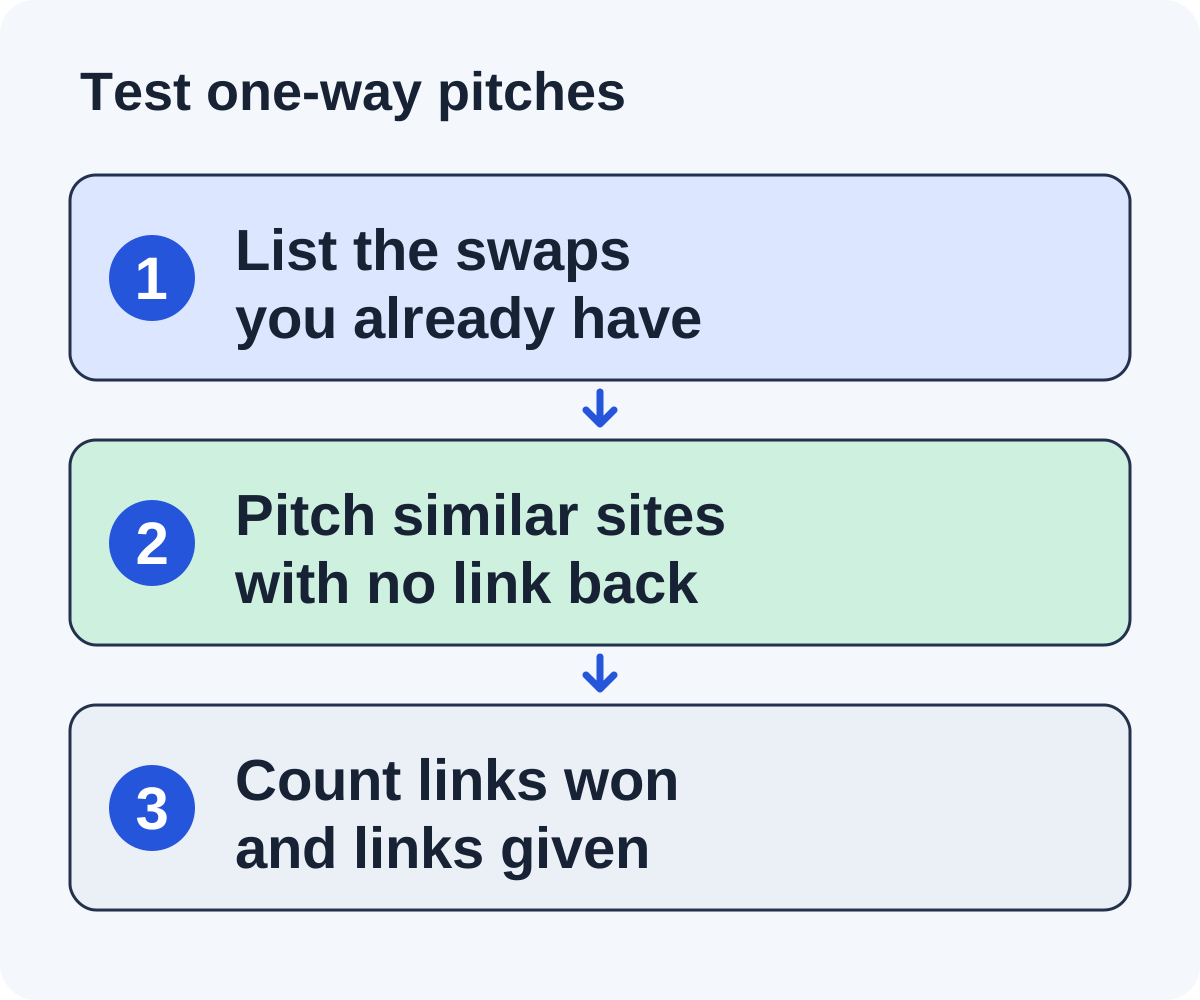
Before you move your outreach, run a small test that puts the two deals side by side. We haven’t run this test on these products ourselves. It’s one for you to try.
Step one: list the swaps you have
Write down every live swap: their page, your page, the date and whether both links are still up.
Step two: pitch similar sites one way
Pick a similar number of sites in the same niche. Pitch them for a guest post or a link insert, with no link back on offer, using the tool you’re testing or by hand. Allow for any warm-up before the first email.
Step three: count links won and links given
For each side, add tool fees, site fees and your hours, and divide by the live links. On the swap side, also count the links you gave away.
If the one-way side wins enough links at a cost you can live with, you have your answer. If almost every editor asked for a swap, your niche may run on them, and MentionAgent may suit you better. The worksheet linked below this guide has a column for each side. Choosing between several tools? Our guide on how to choose link building outreach software walks through it.
Questions about MentionAgent and its alternatives
How much does MentionAgent cost?
On October 18, 2026, the price depended on sending inboxes. One inbox cost $99 a month, two cost $179, four $329 and eight $629. Each inbox sends up to 40 emails a day once warm. A site can use two inboxes, or up to four if you add inboxes at $80 a month each. Plans are month to month, with a full refund within 14 days.
Does MentionAgent pay sites for links?
No. It doesn’t buy placements, and its agent turns down sites that ask for a fee. BacklinkGPT pays within a budget you approve. Linkade keeps sites that charge and leaves the choice to you.
Do I have to link back with MentionAgent?
Usually. Most of its deals are mutual mentions, so you add a line about the other site to a post you’ve already published. Some editors add you with nothing in return.
Can I keep my sending domain if I leave?
Yes. MentionAgent hands the domain over for free when you ask, even after you cancel, though domain rules block a move for the first 60 days after it’s registered. The inbox keeps receiving replies until the end of the period you paid for, and it exports your prospects, threads and send history on request.
Which alternative is closest to MentionAgent?
BacklinkGPT, if you want an agent that writes the pitches and drafts the replies. It sends from your own inbox rather than a new domain, and it will pay sites within your budget. Linkade is close on finding sites and sending from a separate domain, but you write the replies.
Can I use MentionAgent and Linkade together?
Yes, as long as they don’t pitch the same sites. Give each tool the other’s list. Linkade won’t write to any site you tell it to leave out.
Put it to work
Use the companion worksheet to apply the decisions in this guide to your own campaign.
Download the worksheet (.txt)Sources and further reading
See what is worth pitching for your site.
Linkade finds relevant pages and writes pitches from their content. Add your domain and inspect prospects before choosing a paid plan.
Start free