Link Building Outreach: A Practical Workflow for Small Teams
By Jake14 min read
On this page
Link building outreach is the process of asking a publisher to reference a useful page on your site. A good campaign connects a specific resource with a specific editorial need. This guide walks through that connection, from the asset you choose to the placement you verify, with a small-team example you can adapt.
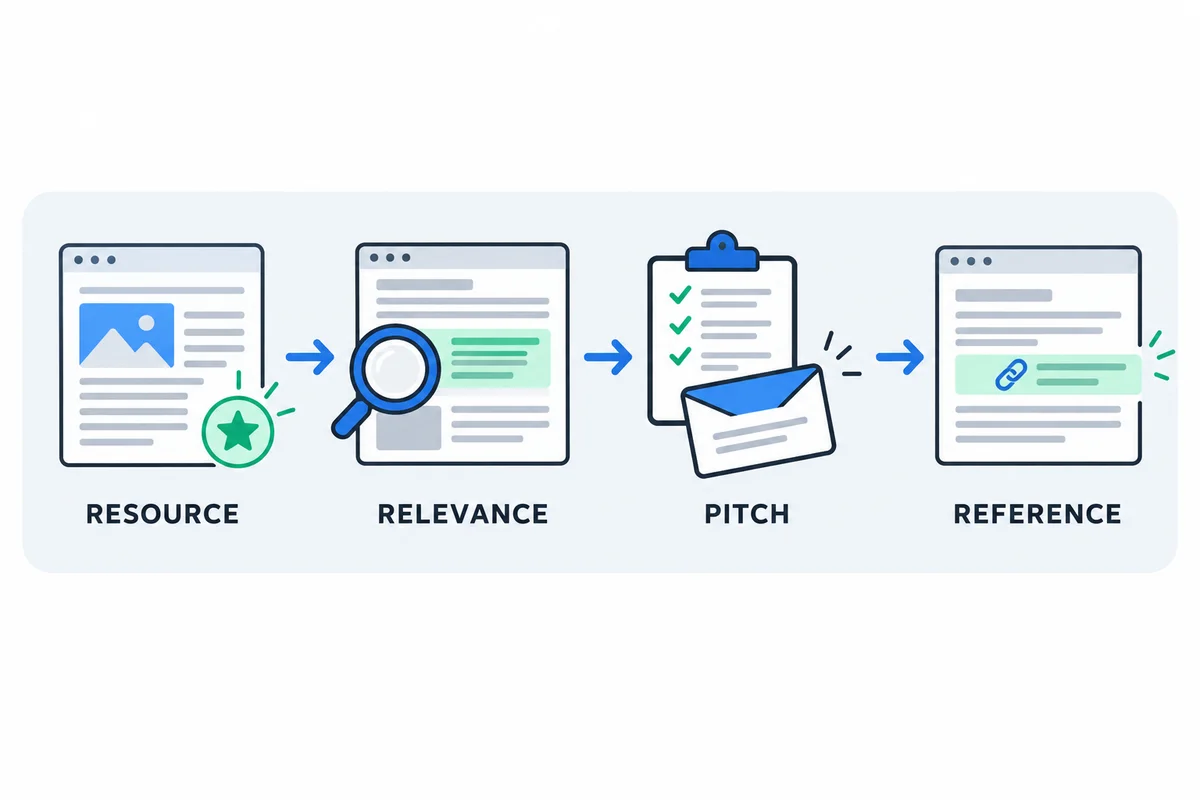
What you’ll learn
- Choose a resource an editor can evaluate without a sales call.
- Qualify the actual page and contact before writing.
- Open with a short email that asks whether they are interested, with no link.
- Track replies and live references separately.
Start with something worth referencing
Before finding email addresses, decide what you are asking someone to cite. A landing page can fit a product roundup. A calculator, benchmark, or tutorial can fit an instructional article. These are different requests: the resource must match the job the referring page is doing.
Write one sentence that describes the reader benefit. “Our tool helps businesses grow” is too broad. “This worksheet helps a founder calculate monthly recurring revenue when refunds and annual subscriptions are involved” gives an editor something to assess.
For the example in this guide, imagine a fictional subscription analytics company with a public MRR worksheet. The worksheet includes formulas, a worked calculation, and assumptions. This is an illustrative campaign, not a customer case study or a claim about results.
Open your proposed destination in a private browser window. Can a reader access the promised material? Is the explanation understandable without creating an account? Are the formulas and examples accurate? Fix the resource before pitching it.
Make the resource easy to inspect
An editor should be able to understand the main value without opening a gated sales flow. Put the example, assumptions, and author or maintainer information near the resource. If it is a calculator, state the input units and what the result means. If it is a benchmark, explain the sample and collection method. If it is a checklist, show what a completed decision looks like.
Test the destination on a phone and in a private window. Check that the useful content is actually visible, links work, and the core promise is not hidden behind an account requirement you failed to mention. A free download can be helpful, but a downloadable cover with no usable material does not fulfill the pitch.
Build a campaign brief before collecting prospects
A campaign brief connects the business objective with the editorial request. Without it, you can collect hundreds of superficially relevant pages and still have nothing useful to say to their editors. Put the brief in the same place as your prospect list so that whoever reviews the draft can see the assumptions.
For our fictional SaaS analytics company, the objective is to introduce a public MRR worksheet to founders who are already learning subscription accounting. The destination is the worksheet, not the homepage. The contribution is a worked refund calculation. The preferred referring context is an explanation of annual subscriptions, and the person to contact is whoever maintains that explanation.
Define the five inputs
- Audience: who should benefit from the reference?
- Destination: the exact public URL and the resource it contains.
- Contribution: what a publisher’s current page does not already explain or provide.
- Editorial formats: tutorials, collections, or product comparisons that can reasonably use it.
- Constraints: available review time, supported product claims, and arrangements you will decline.
Write a rejection rule alongside the inclusion rule. In this example, an enterprise accounting directory fails if it offers no instructional context for a founder worksheet. A tutorial with the same complete calculation fails the missing-contribution test. Those rejections protect the campaign’s focus; they are not judgments about the publisher’s overall quality.
Decide who owns the asset, prospect review, sending approval, and replies. One person can own all four in a small team, but the tasks still need explicit time. A founder who has forty minutes for review should not approve a campaign that will require several hours of unanswered editorial conversations.
Find pages with a reason to include it
Search around the reader’s problem: recurring revenue calculations, SaaS finance resources, and subscription reporting guides. Record candidate page URLs, not just domains. A finance publisher may be relevant overall while its particular article is about payroll.
Read each candidate’s relevant section. Our fictional worksheet might fit a guide that explains MRR but gives no example of annual-plan normalization. It would be a weak fit for a list of enterprise accounting software if the product is designed for tiny SaaS teams.
- Audience: Is the page written for someone who could use the resource?
- Context: Is there a specific section where the reference would help?
- Contribution: Does the resource add information or a useful action?
- Maintenance: Is there evidence the publisher still maintains the page?
Keep an explicit rejection reason. “No relevant section” is useful information; it prevents the same poor candidate from returning in the next campaign. See the prospecting guide for a fuller qualification process.
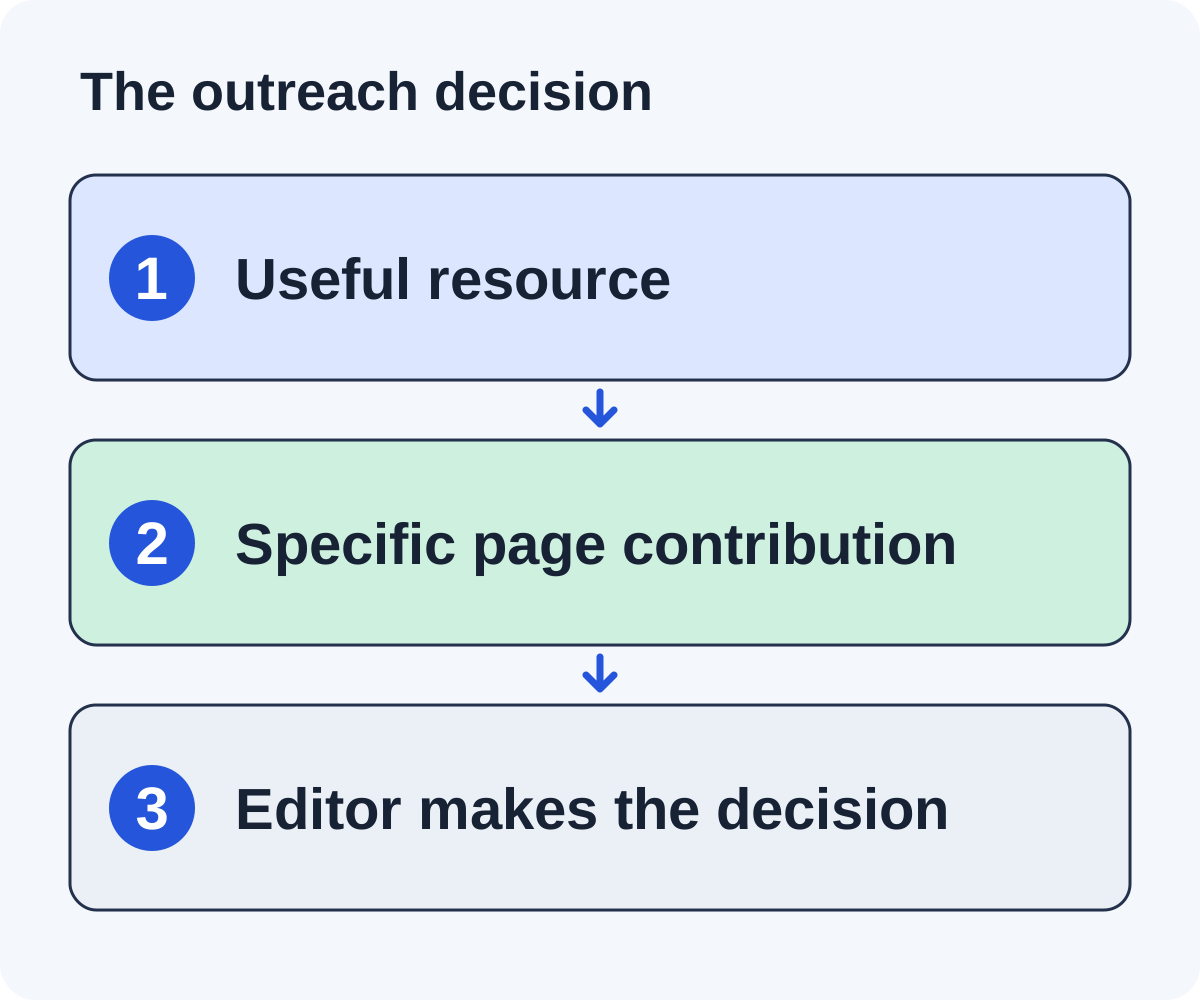
Identify the editor and preserve your evidence
Look for the page author, editorial team, or submission instructions. A publicly listed role is a stronger starting point than guessing that a generic executive owns the article. Record where you found the contact and why that person is responsible for this page.
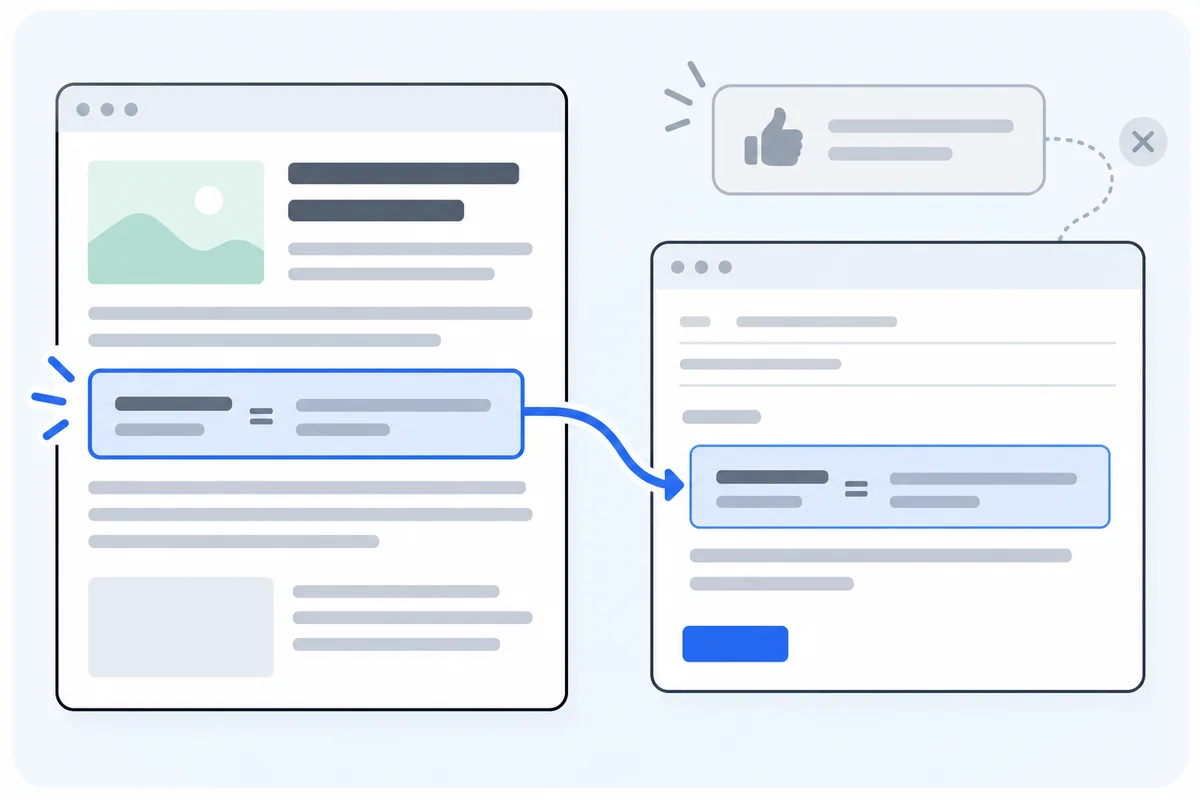
Save the page title, section heading, observed gap, and date checked. Keep a short excerpt only where needed to document the observation. You should be able to explain the pitch after the page changes or another teammate takes over.
For the fictional example, the evidence note could read: “The ‘Annual subscriptions’ section describes dividing contract value by twelve, but does not show a refund adjustment. Our worksheet includes that calculation.” If the section already has the same example, the reason to pitch has disappeared.
Review contact suitability under your organization’s approved outreach policy. A published address does not by itself establish that every kind of message is appropriate.
Write the smallest complete pitch
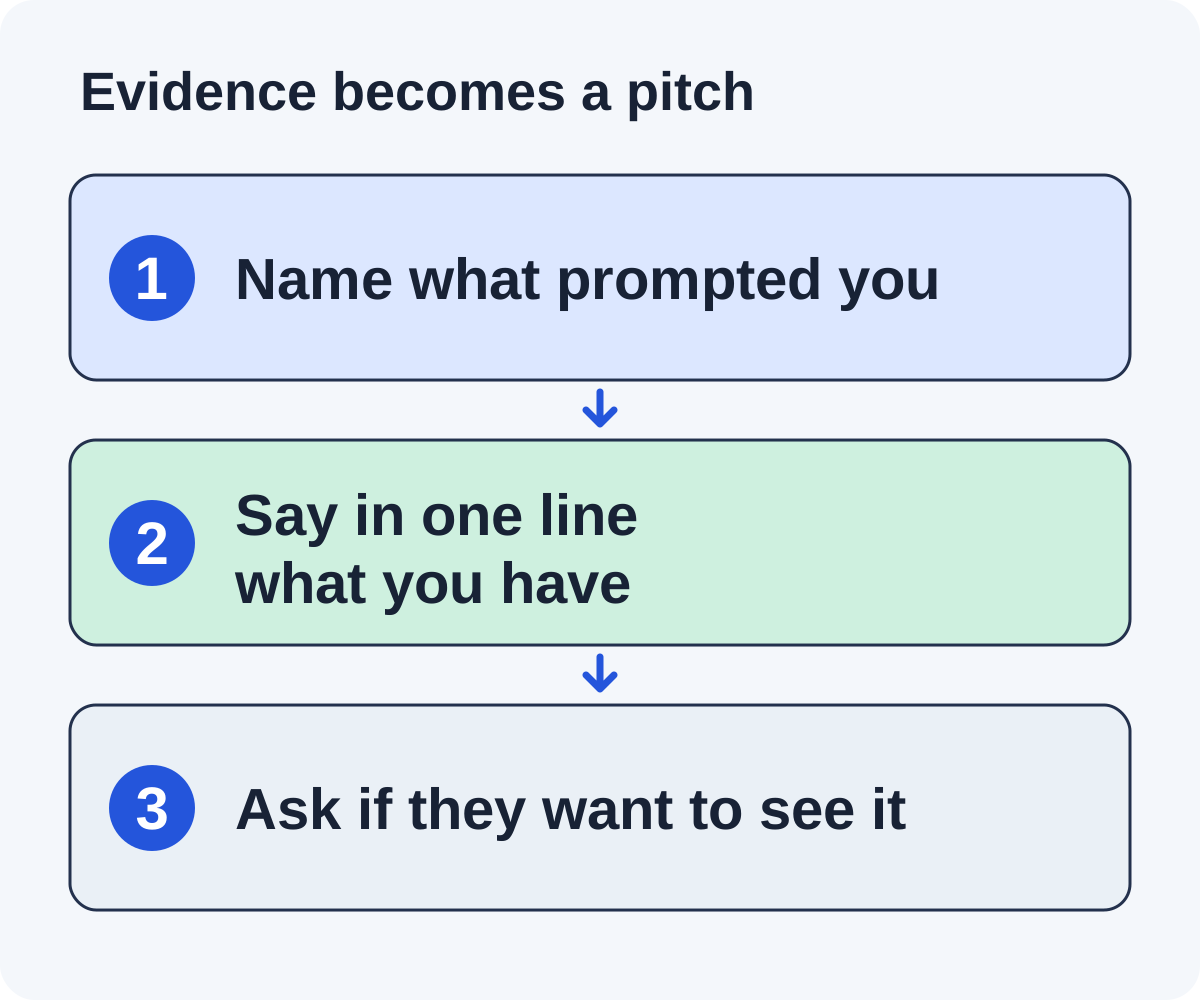
A useful first email names their site or the topic they cover, says who you are, and asks one question: would they be open to a guest post or a link suggestion? It carries no link and does not list what their page is missing. It does not need a long biography or an invented compliment. Keep your page observation and the resource for the message you send after they say yes.
Hi Alex, I read your MRR guide, including the part on annual subscriptions. I work at a small subscription analytics company. Would you be open to a link suggestion or a short guest post on SaaS revenue metrics? If so, I can send the details.
After they say yes, the second message carries the detail and the link:
Thanks, Alex. The worksheet is at [real URL]. It walks through a refund on an annual plan with the formulas visible, so it could sit beside your annual-subscription section as an example. Happy to send the calculation details if helpful.
These samples assume the facts are true. Replace them with your own verified facts and use an accurate sender identity. Leave the URL out of the first email and give it only once the editor has said yes. Don’t describe a feature the asset does not contain.
Check that the request leaves the editorial decision with the publisher. Avoid requiring a particular keyword anchor, promising a reciprocal link, or treating a mention as an obligation. Google’s spam policies identify link arrangements made primarily to manipulate rankings as link spam.
Work through one opportunity from search to pitch
Here is an end-to-end exercise using invented pages and people. It demonstrates how to make the decision; it does not represent a real Linkade customer, placement, or measured result.
1. Search for a reader problem
Begin with queries such as MRR annual subscriptions calculation, SaaS finance resources, and monthly recurring revenue refunds example. A query is a discovery route, not proof of suitability. Open a candidate and check whether its main content serves the audience in your brief.
2. Write a page observation
Imagine a candidate article called “MRR calculations for early-stage SaaS.” Its annual-plan section explains dividing subscription revenue by twelve, but the example never handles a refund. Your evidence note records the exact section, the missing example, and the date checked. Another candidate already has a complete refund example. Reject the second candidate rather than inventing a different excuse to contact it.
3. Test the contribution
Work through the worksheet yourself. A fictional customer pays $1,200 for a year, which normalizes to $100 per month before adjustments. Your example must define whether the refund changes recognized revenue, the recurring subscription amount, or a reporting correction. Those are different concepts. If the worksheet treats them as interchangeable, fix the explanation before pitching a finance editor.
4. Find the responsible person
The candidate lists an author and an editorial contact page. Check which person handles updates. Record the public source and role in the prospect row. If the author no longer contributes to the publication, a current editorial address with appropriate submission instructions can be the better path.
5. Write a reviewable request
Keep the evidence note for later and write a first email with one question. For example: “Hi, I read your article on MRR calculations for early-stage SaaS. I work at a subscription analytics company. Would you be open to a link suggestion or a short guest post on that topic?” Leave out the URL, the missing refund example, and any request to add a link. If the editor says yes, reply with the observation, what the worksheet supplies, the actual resource URL, and an accurate sender identity.
6. Verify what happened
If the editor agrees to look, record a conversation rather than a placement. If the page is updated, check the actual destination and surrounding explanation. If the editor uses the example without linking, record a mention. Keeping those states separate prevents your report from turning a positive reply into an invented backlink.
Send with controls and handle the response
Choose a first batch small enough to review every message and reply. Ten carefully inspected prospects can be a sensible planning exercise for a new workflow; ten is an example batch size, not a proven optimum.
Before release, verify the sender, recipient, claims, and follow-up stop conditions, and keep the destination URL ready for the reply after a yes. If an editor replies, pause the automated sequence and handle the actual conversation. A decline or opt-out is a stop signal, not an invitation to try a different mailbox.
One restrained follow-up may be appropriate when your policy permits it and the request remains useful. A short nudge that repeats the question is enough; keep the link and the detail for after a yes. Repeating “checking in” indefinitely does not improve the resource.
Linkade finds relevant sites, judges each one on its metrics and fit, finds a printed or verified contact, and writes a short first email that asks whether the publisher is interested. In Copilot you approve each email before it sends; in Autopilot, Linkade sends without asking. You write every reply yourself. Choose the level of review your campaign needs; software still needs accurate product information and clear boundaries.
Verify the reference and learn from the batch
A positive reply is not a live placement. Open the referring page and inspect the actual link: destination, surrounding text, link attributes, and date verified. Record a page that mentions you without linking as a mention rather than a backlink.
For the illustrative batch, suppose ten pitches produce three replies and one live reference. That is a fictional arithmetic example: a 30% reply rate and 10% placement rate for those ten contacted prospects. It is not a benchmark or an expected outcome.
Review why the other prospects did not fit, what questions editors asked, and whether the resource needs improvement. If editors repeatedly ask for a clearer calculation, improve the worksheet before expanding the list.
Measure search and referral activity separately from outreach operations. A placement can be useful without proving a ranking change. Use the companion checklist to keep the evidence, decision, and result together.
Keep outreach outcomes separate from business outcomes
Your operational report can say how many qualified opportunities, sent messages, replies, and verified references a defined cohort produced. A separate business report can examine referral visits, useful signups, and search activity. Preserve the observation window and other changes to the site. A ranking movement after a campaign is not, by itself, evidence that the outreach caused it.
Store the verified referring URL, destination, observed attribute, date, and context. A later recheck can reveal a removed link or changed destination. If the resource changes substantially, update the example so the original referring context still makes sense.
Troubleshoot the campaign before expanding it
When a batch performs poorly, identify the earliest failing stage. “Outreach does not work” is too vague to guide a correction. Review discovery, qualification, drafting, delivery, conversation handling, and placement verification separately.
Most candidates fail qualification
Narrow the search around the audience and editorial format. Add a missing-context rejection rule. If a product roundup needs a software category you do not serve, replace the discovery query instead of writing a more persuasive pitch.
Accepted prospects produce generic drafts
Look at the evidence note. “Relevant SaaS article” does not contain enough information to write a specific email. Add the section, the observed reader problem, and the contribution. A drafting tool can reorganize those facts; it cannot create a true editorial need.
Messages receive delivery failures
Pause that recipient or sending route and inspect the actual failure. Do not keep following up to a bounced address. Review address discovery, authentication, and the sender’s current provider requirements. Delivery preparation deserves its own check before judging the asset or pitch.
Editors ask questions nobody can answer
Give the reply owner the resource assumptions and product facts. If a question exposes an incomplete example, improve the destination before adding more prospects. A credible clarification can help the editor assess the resource; an unsupported claim makes the original pitch weaker.
Replies look positive but nothing is published
Record the actual next action and any stated timeline. An editor may need to verify a formula, wait for a scheduled update, or decide against inclusion. Measure a live reference only after you inspect it. A short conversation is still useful research even when it does not produce a link.
Use the worksheet to retain one decision from each batch: which discovery route to keep, which asset explanation to improve, and which drafting assumption to remove. Change one identifiable weakness before increasing volume so that you can understand what changed.

Common questions about link building outreach
How many prospects should a first campaign contain?
Choose a number your team can research, review, and reply to completely. A ten-opportunity pilot is a useful exercise when you can inspect every page and message. It is not a universal recommendation or a predicted success threshold. If ten creates a backlog, use fewer. If the first ten do not fit, fix discovery before collecting a hundred.
Should I pitch the homepage or a resource?
Use the destination that fulfills the editor’s task. A software roundup may need your product page, including its actual audience and capabilities. A tutorial may need a calculator or worked example. Sending the homepage merely because it is commercially important does not make it the best reference for an instructional section.
What belongs in the first email?
Name their site or the topic they cover, say who you are, and ask whether they would be open to a guest post or a link suggestion. Leave out the resource URL, any list of what their page is missing, and any request to add a link; those belong in the reply after they say yes. Leave a full company history, unrelated feature list, and speculative ranking claims out entirely.
Is a nofollow link a failed placement?
Record the link attribute accurately, then evaluate whether the reference helps readers and fits your campaign objective. Do not redefine a real editorial reference as nonexistent because it carries an attribute you did not prefer. Also do not claim a specific search benefit merely because a link is present.
When should I use automation?
Use it for a task you can describe and inspect: collecting candidate pages, retaining evidence, preparing drafts, or tracking states. Keep the approval decision visible while the workflow is new. A draft should stop when the required evidence is missing, and a reply or opt-out should change the sequence immediately.
Put it to work
Use the companion worksheet to apply the decisions in this guide to your own campaign.
Download the worksheet (.txt)Sources and further reading
See what is worth pitching for your site.
Linkade finds relevant pages and writes pitches from their content. Add your domain and inspect prospects before choosing a paid plan.
Start free