Domain Rating vs Page Relevance in Link Prospecting
By Jake9 min read
On this page
Domain Rating is an Ahrefs metric about a website’s backlink profile. Page relevance asks whether the specific page and reference serve your audience and resource. Use the metric as a comparison signal, then make the outreach decision from the actual editorial context.

What you’ll learn
- Keep a provider’s domain metric separate from page fit.
- Record metric source, scope, and observation date.
- Use relevance gates before sorting qualified opportunities.
Understand what the metric describes
Ahrefs defines Domain Rating as a measure of backlink-profile strength on a 0–100 scale. Its API documentation describes the scale as logarithmic. It is a provider metric, not a direct observation of your proposed placement.
Ahrefs also states that Domain Rating is not a search-engine ranking factor. Do not present a DR threshold as Google’s acceptance rule or promise a ranking benefit from reaching it.
Different providers use different metrics. Preserve the name and provider instead of labeling every number “authority.” Missing data should remain unknown rather than being converted into a score of zero.
Keep provider signals and editorial observations separate
Use two groups of fields in your qualification record. The first contains provider signals: metric name, provider, value, scope, and retrieval date. The second contains page observations: audience, section, resource need, existing references, and your contribution. Combining them into one unexplained “quality” number hides the reason for the decision.
Domain Rating summarizes a backlink profile at domain level. It cannot tell you whether a specific paragraph needs your worksheet, whether the resource is accessible, or whether the publisher accepts additions. Those questions require page-level evidence and policy review.
Missing provider data should stay unknown. A small publication may not have an available metric in your tooling. That absence is not proof of poor relevance or a score of zero. Record what you can inspect and decide whether the missing signal matters to your organization’s prioritization policy.
Keep other provider metrics under their own names. A traffic estimate, authority score, referring-domain count, and DR are not interchangeable. Do not present them as measured readership of the exact referring page unless the underlying data actually supports that claim.
A reviewer should be able to understand the opportunity even if the metric column is hidden. If the only reason left is “the score was high,” the campaign has not established a useful editorial contribution.
Evaluate the page before the domain score
Read the candidate page and identify its audience, task, relevant section, and current references. Then compare your resource with the contribution that section needs.
A high-scoring domain can publish a page unrelated to your audience. A specialist page on a smaller site may have a clear reader match. The score does not answer whether your worksheet belongs in that paragraph.
Use three gates: reader fit, editorial fit, and useful contribution. A failure at one of these gates should not be erased by a high domain metric.
Keep contact suitability, sending eligibility, and placement transparency as separate decisions. Neither page relevance nor DR alone completes the campaign review.
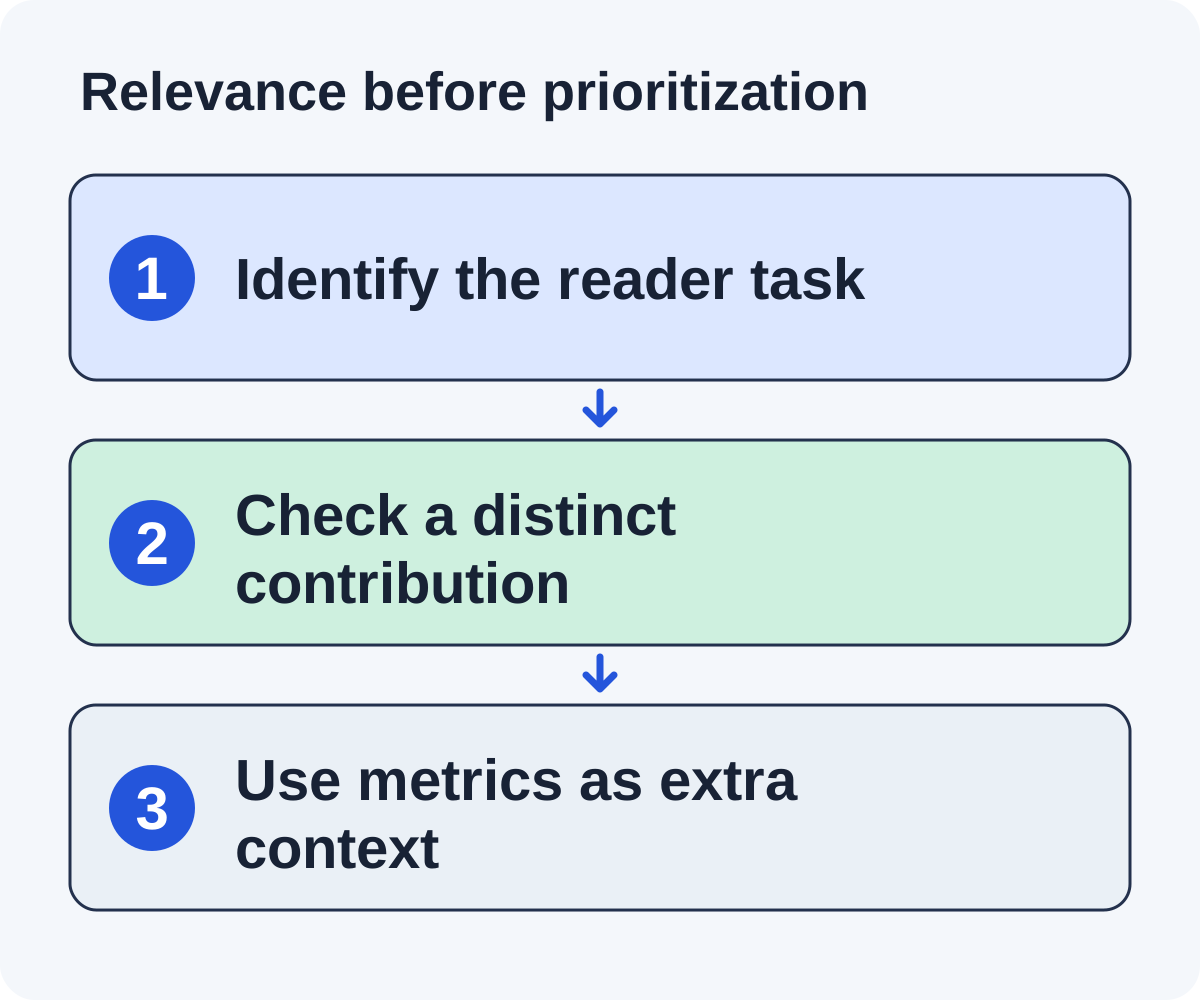
Apply a relevance gate to three fictional candidates
Assume your asset is a public SaaS refund worksheet. The metric descriptions and candidate pages below are invented for the exercise; they are not observations about real publishers.
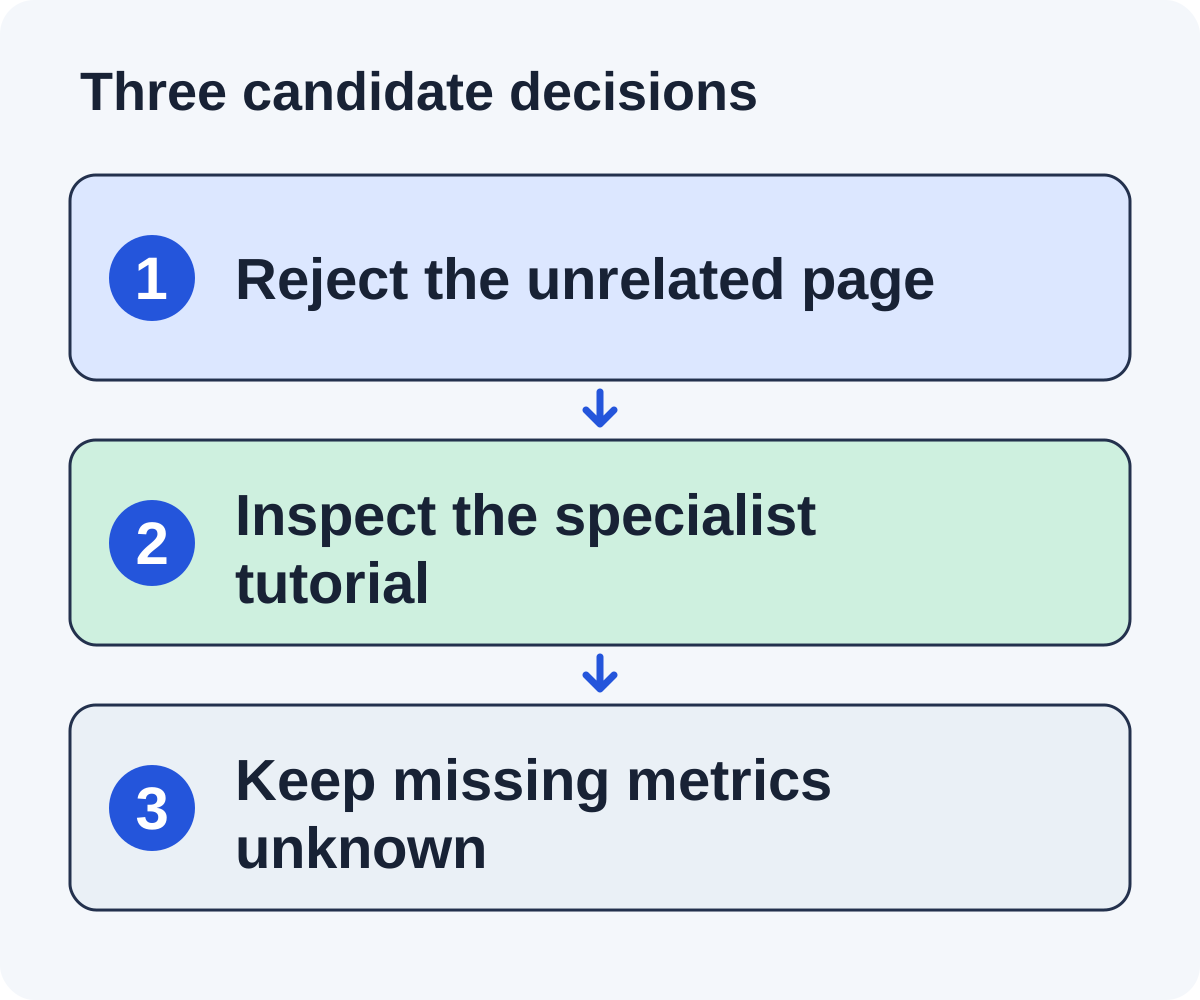
- General sports news on a high-scoring domain. The page discusses a match result and contains no SaaS calculation context. Reject it for audience and task mismatch. The domain signal cannot create a sensible reference inside that story.
- A specialist SaaS finance tutorial with a modest score. The annual-plan section explains MRR but omits a worked refund case. Inspect your worksheet’s fit, check whether existing references already supply the example, and verify the contact route. If those checks pass, the page can be a useful candidate.
- A founder resource collection with unknown DR. The finance category includes public worksheets. Inspect the collection’s criteria, ownership, access, and existing coverage. Unknown metric data leaves prioritization incomplete; it does not automatically fail editorial fit.
For the specialist tutorial, write the actual reason: “The refund example may help readers complete the annual-plan calculation.” That sentence supports a grounded pitch. “Your site has strong metrics” does not tell the editor why another reference belongs.
Now consider a changed observation: the tutorial already links a worksheet covering the same refund case. The candidate may no longer have a distinct contribution even though its relevance is high. Relevance is necessary to investigate the opportunity; it is not evidence that every relevant page needs your resource.
Keep fit, differentiation, contact suitability, sending eligibility, and placement terms as separate decisions. A candidate should not become ready because one field passes while an essential field remains unresolved.
| Candidate | Domain signal | Page decision |
|---|---|---|
| A general news page about sports | Strong provider estimate | Reject: no relevant calculation context. |
| A specialist SaaS finance tutorial | More modest provider estimate | Consider: worksheet may complete the example. |
| A founder resource collection | Metric unavailable | Investigate page fit; missing data is not rejection. |
Inspect the specialist tutorial for duplication and maintenance before accepting it. Relevance is a starting gate, not a complete quality guarantee.
Use metrics to prioritize an already qualified list
Once a page passes relevance checks, a domain metric can help compare or order candidates alongside other observations. Record the provider, metric value, query scope, and date so another reviewer understands the signal.
Do not invent universal cutoffs such as “only pitch DR 50 or higher.” If your organization uses a threshold, explain why and review exceptions. A business requirement is different from a verified search-engine rule.
Look at missing and rejected cases when evaluating the filter. How many relevant pages did it exclude? How many unrelated pages did it admit? Your campaign records can help assess the operational tradeoff.
Keep the result as a prioritization aid. It should not turn into a promised placement value, traffic forecast, or substitute for reading the page.
Evaluate a score threshold using your own rejected cases
If your organization uses a DR threshold, treat it as an operating rule to assess, not a search-engine requirement. State its purpose: perhaps limiting a review queue or meeting a contractual criterion. Preserve relevant exceptions and missing data so the rule’s tradeoff is visible.
Review a sample before and after the filter. Count relevant pages excluded, irrelevant pages retained, and unknown cases sent to investigation. Do not only inspect the accepted list; that cannot show what the filter removed.
For a fictional sample of ten candidates, suppose five pass relevance checks. A score threshold retains three of those five and also retains two irrelevant pages. The rule reduced the list but did not complete qualification. These numbers illustrate how to inspect a filter, not a typical result or an argument for a particular cutoff.
Compare effort and output. Did the rule reduce review time while preserving the useful opportunities your team values? Did it disproportionately hide specialist publications? Would applying the relevance gate first make the remaining prioritization simpler?
Keep your conclusion operational. You can say that a filter admitted unsuitable pages in your reviewed sample. You cannot infer the ranking value of the excluded references from that sample. Use observed placements and business outcomes for their own reporting purposes.
Make the decision explainable
A complete record says: this page serves this audience; this section has this need; this asset provides this contribution; this provider metric was observed on this date; and this contact route has been checked.
That explanation is useful to a reviewer and to the eventual writer. “DR is high” does not contain enough information to compose a grounded pitch.
After publication, inspect the actual placement using the editorial quality rubric. Track referral and search observations separately from the provider score.
The worksheet helps combine both kinds of evidence without allowing one number to make the whole decision.
Answer common metric questions precisely
Is DR a Google ranking score?
No. It is an Ahrefs metric about backlink-profile strength. Ahrefs explicitly distinguishes it from a search-engine ranking factor. Use the provider’s definition rather than implying that Google evaluates your campaign by the same threshold.
Is a higher DR always the better outreach choice?
The specific page still needs a useful context for your resource. A score can help order qualified candidates, but it cannot supply audience fit, an accurate destination, or editorial eligibility.
Should a page with unavailable metrics be rejected?
Preserve the unknown value and inspect the page. Your organization may have additional requirements, but missing data is not itself a measured negative score.
Can a campaign report DR increases as its result?
You can report a provider observation with its date and scope. Keep it separate from verified references, referral visits, leads, and search performance. A changed provider metric does not establish that your outreach caused a particular search or revenue outcome.
Before sending a pitch, remove the metric from the draft unless it is directly relevant to an unusual factual question. The publisher needs the contribution to its article. Your internal prioritization signal belongs in the campaign record, where it can be checked and revised.
Put it to work
Use the companion worksheet to apply the decisions in this guide to your own campaign.
Download the worksheet (.txt)Sources and further reading
See what is worth pitching for your site.
Linkade finds relevant pages and writes pitches from their content. Add your domain and inspect prospects before choosing a paid plan.
Start free