Link-Building Outreach Costs: Software, Labor, and Placements
By Jake9 min read
On this page
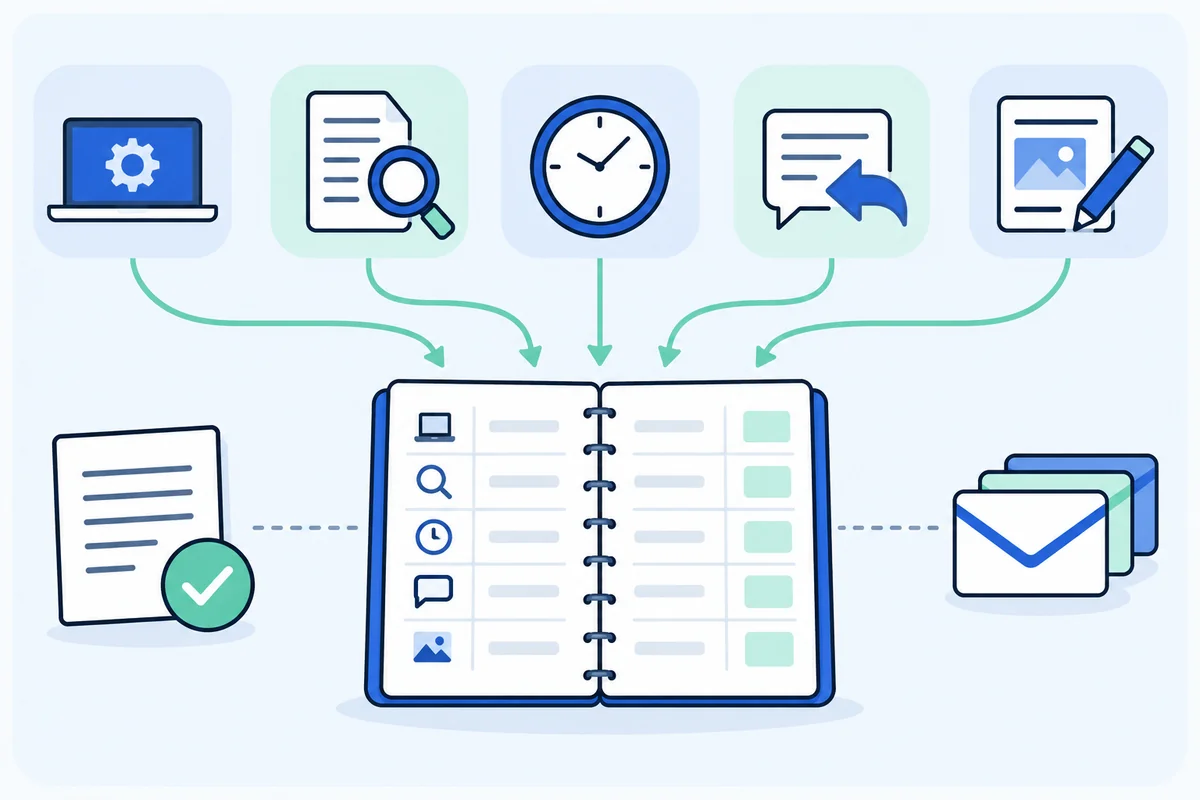
An outreach budget includes software, labor, asset maintenance, and any separate commercial arrangement. A subscription buys a workflow or usage allowance; it does not buy a guaranteed number of editorial references. Build the budget from the work you plan to perform and outcomes you can verify.
What you’ll learn
- Separate subscriptions, labor, and commercial placement costs.
- Use editable assumptions rather than industry-average promises.
- Calculate cost per verified outcome only after observing it.
List the costs by type
Software can include prospecting, contact data, drafting, email operations, CRM, and monitoring. Some products bundle those tasks; others leave you to combine tools.
Labor includes asset preparation, research, review, replies, and verification. Founder time is still a cost even when it does not appear as a contractor invoice.
Asset maintenance keeps the destination useful after the pitch. A calculator or original study may need updates, hosting, or specialist review.
Commercial arrangements are separate from earned editorial outreach. If a publisher offers advertising or a sponsored listing, record the terms and handle disclosure and link qualification appropriately.
Build the budget around one defined campaign
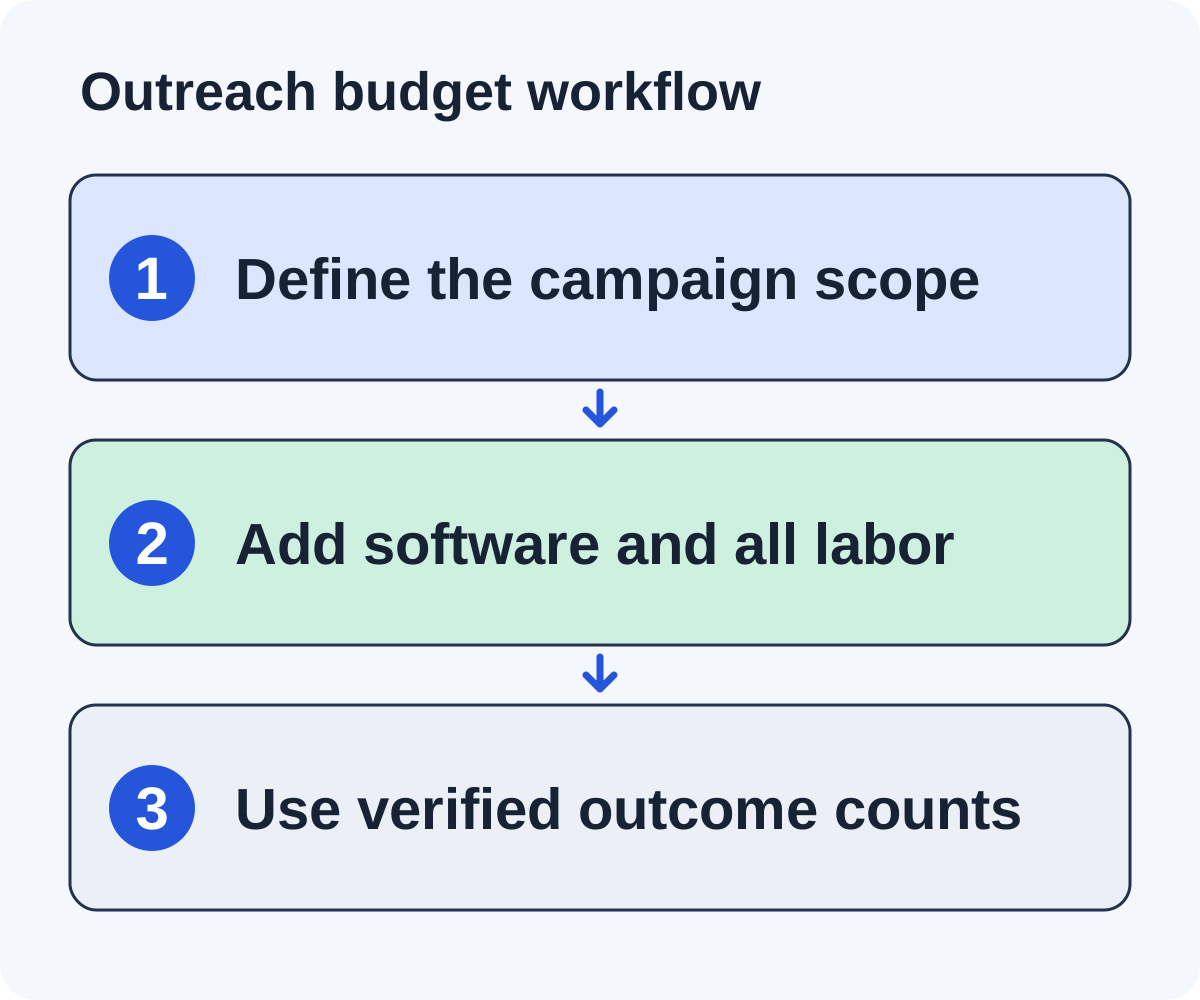
Specify the asset, audience, operating period, and owner before comparing subscriptions. A campaign for one public worksheet has different preparation costs from an original research report or a product launch. The budget should describe that work rather than imply that every outreach program has a standard price.
Separate setup from operation. Setup can include writing the asset, building a worksheet, documenting product facts, configuring sender access, and importing existing publisher history. Operation includes prospect review, drafting, replies, and verification. Show maintenance separately when the resource needs continued updates after outreach ends.
Decide how to value internal time. You can report cash spending alone, or cash plus an assumed hourly cost for founder and staff labor. Either can be useful, but do not compare one team’s cash-only figure with another team’s fully loaded figure as though they measure the same thing.
List exclusions explicitly: taxes, a separate contact provider, original asset development, specialist review, paid sponsorships, or internal overhead. An excluded cost is not zero. Keep invoices and your labor assumptions beside the budget so the team can revise it after the pilot.
Finally, identify the constraint. If review capacity is ten opportunities a week, an allowance for thousands of prospects does not create thousands of reviewed opportunities. Choose a plan against the workload your team can actually operate.
Compare units and commitments
Linkade’s standard Starter plan is $149 monthly for one workspace and 2,000 prospect credits. Growth is $399 for three workspaces and 6,000 credits. The Founder plan is $99 monthly, open only to the first 20 teams, who keep that price for life. One credit is one qualified prospect; writing and sending emails are included. See current plan details.
For comparison, the Pitchbox pricing page, checked October 5, 2026, shows Pro at $300 monthly billing or $210 as the annually billed monthly equivalent. Its FAQ states a one-year commitment regardless of billing frequency. Confirm the applicable offer before purchase. Linkade vs Pitchbox sets the two side by side on contract, setup and features.
Do not compare contact storage, prospect credits, searches, and outreach messages as equivalent units. Work out how each allowance supports your intended campaign.
Budget the capacity you will use, not the largest number a plan advertises. If you can review only a small batch, a high sending allowance may provide little practical value.
Build an illustrative monthly budget
Here is an example using assumptions, not industry averages or a customer result. Suppose a team chooses a $149 subscription and values its labor at $50 per hour.
| Work | Assumed time | Assumed cost |
|---|---|---|
| Asset maintenance | 2 hours | $100 |
| Research and review | 6 hours | $300 |
| Replies and verification | 2 hours | $100 |
| Software | Monthly subscription | $149 |
Total planned cost is $649: $500 of assumed labor plus $149 of software. No paid placements or other tools are included. Replace every input with your own rate, measured hours, and subscriptions.
If asset development is a one-time project, show it separately from recurring maintenance. Amortizing it across several months can be useful for planning, but disclose the period and assumptions.
Model low, base, and high labor scenarios
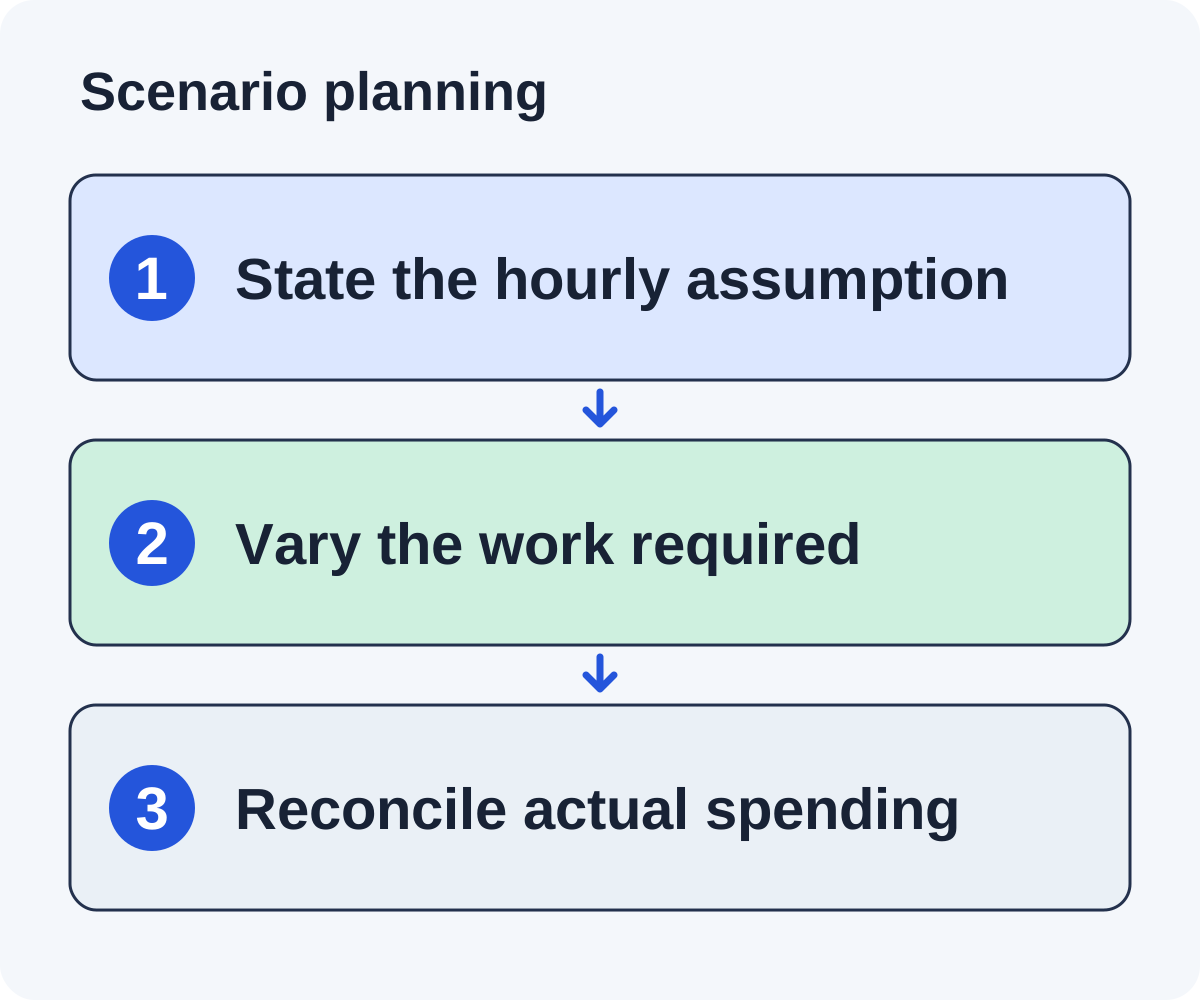
A scenario model exposes uncertainty without promising a link count. Assume a $149 monthly subscription and value labor at $50 per hour. The following hours are invented planning inputs. Asset creation, other subscriptions, taxes, and paid placements are excluded.
| Scenario | Assumed labor | Labor cost | Total with software |
|---|---|---|---|
| Low effort | 6 hours | $300 | $449 |
| Base effort | 10 hours | $500 | $649 |
| High effort | 16 hours | $800 | $949 |
The spread reflects labor uncertainty, not different promised outcomes. A difficult contact review, asset correction, or detailed editor question can consume more time than expected. Replace these inputs with your own measured tasks and rate.
For sensitivity analysis, change one input at a time. At ten hours, raising the assumed labor rate from $50 to $75 changes labor from $500 to $750 and the total from $649 to $899. A higher subscription cost can be reasonable if it reduces enough useful work, but you need an observed pilot to support that claim.
Compare a saved hour with the full change in operating cost. A hypothetical $100 monthly tool difference requires two saved hours at the assumed $50 rate just to offset that difference. It does not prove the upgrade will save those hours. Include onboarding, checking, and data migration in the evaluation.
Record your assumptions before buying. After the campaign, replace planned hours with actual hours and explain meaningful deviations. This gives the next budget a factual starting point rather than another round of optimistic guesses.
Calculate outcome costs after verification
Cost per verified placement is campaign cost divided by verified placements for a defined cohort and observation period. Define which costs and placements belong in that cohort before calculating.
If the fictional $649 campaign later produces four verified placements, the arithmetic is $162.25 per placement. Four is an assumed outcome for this example, not a forecast. If there are zero verified placements, report the cost and zero result; there is no meaningful finite cost-per-placement figure.
Track cost per accepted prospect and cost per useful conversation as operational measures too. Keep them distinct from placement cost. A reply cannot be counted as a live reference.
Do not multiply estimated traffic by an invented conversion rate and call it realized ROI. Use observed business outcomes and acknowledge attribution limits.
Match cost denominators to verified states
Cost per prospect, cost per conversation, and cost per placement answer different questions. Define each denominator. An imported candidate is not a qualified opportunity; an automated reply is not an editorial conversation; an editor’s promise is not a live reference.
In another fictional example, a $649 cohort contains 40 inspected candidates, 20 accepted opportunities, six substantive conversations, and four verified references by the cutoff date. Cost per accepted opportunity is $32.45. Cost per substantive conversation is approximately $108.17. Cost per verified reference is $162.25. These are calculations from assumptions, not benchmark rates.
Keep one cohort and observation window across these figures. If you add references from older campaigns to the denominator while using only this month’s spending, the apparent placement cost becomes misleading. Likewise, costs for an asset used across several campaigns need a stated allocation rule.
With zero placements, report the spend and zero verified references. Do not substitute a promised link to avoid an undefined ratio. With a small number of placements, show the count beside the ratio so a single late addition does not look like a major productivity breakthrough.
Business return requires observed business outcomes and careful attribution. Referral visits, qualified leads, customer conversions, and search changes can occur on different timelines. Report their evidence separately; do not multiply an invented traffic estimate by an invented conversion value and label it realized ROI.
Use the budget to decide what to change
If qualification absorbs most of the labor, improve discovery criteria or evaluate research support. If replies create a bottleneck, assign capacity before adding sends. If editors find the asset unhelpful, spending more on outreach may not fix the problem.
Google’s commercial-link guidance is relevant when evaluating sponsored arrangements. Do not equate paying an outreach service for labor with buying undisclosed ranking credit.
Review actual costs and outcomes by campaign rather than presenting one number as a universal benchmark. Keep assumptions, invoices, and verification dates together.
The task ownership guide helps decide which work should stay with your team. The worksheet turns those decisions into an editable budget.
Allocate an asset used by several campaigns transparently
Suppose a fictional team spends $900 creating a public migration resource and later uses it in three campaigns. It can report the creation cost as a separate project expense or allocate it across campaigns for planning. Either approach needs a stated rule.
An equal allocation would assign $300 to each campaign. That is an accounting assumption for this example, not evidence that each campaign received equal benefit. An allocation based on observed use would need its own data and definition. Do not switch methods later solely to improve a reported placement cost.
Keep recurring maintenance separate. If the team spends two assumed hours updating the resource in one month, include that work in the appropriate operating period or disclose another allocation. The resource’s original creation and its later upkeep are different costs.
For a report, show campaign operating spend, allocated asset cost if used, total defined spend, and excluded items. A reader should be able to reproduce the arithmetic from those inputs.
Compare the same scope across alternatives. A service quote that includes original asset creation is not directly comparable with a software subscription supporting only outreach. Add the missing internal work before deciding which model costs less.
Allocation makes planning possible; it does not establish revenue attribution. Keep observed leads or customer activity separate and acknowledge when you cannot tie an outcome to one campaign or one reference.
Compare plans and service quotes without mixing units
A prospect credit, stored contact, search, email account, and sent message are different units. Ask where the unit is consumed and what work is included. In Linkade, one credit is one qualified prospect; included email writing and sending remain subject to the sender’s operating limits. A credit is not a guaranteed editorial placement.
Read contract terms separately from the monthly equivalent. Pitchbox’s own pricing page currently shows different billing amounts and states a one-year commitment in its FAQ. Confirm the applicable offer directly before purchase. A monthly payment schedule does not by itself establish a month-to-month contract.
For an agency quote, request the deliverables, review responsibilities, asset work, contact methods, commercial placement policy, ownership of records, and exit procedure. A service may reduce your execution labor while still requiring product expertise and approvals from your team. Linkade vs Respona compares paying per placement with a monthly tool.
Should I buy the largest allowance to lower unit cost?
Only compare against capacity you expect to use. Unused allowance does not become useful output. Start with review and reply capacity, then select a plan that supports that campaign.
What if the first batch gets no placements?
Inspect the bottleneck before spending more: fit, contact ownership, asset usefulness, unanswered questions, or insufficient observation time. The budget records the result; it does not prove that more sending will solve the problem.
Put it to work
Use the companion worksheet to apply the decisions in this guide to your own campaign.
Download the worksheet (.txt)Sources and further reading
See what is worth pitching for your site.
Linkade finds relevant pages and writes pitches from their content. Add your domain and inspect prospects before choosing a paid plan.
Start free