Agency vs In-House Link Building: Compare the Work and Costs
By Jake8 min read
On this page
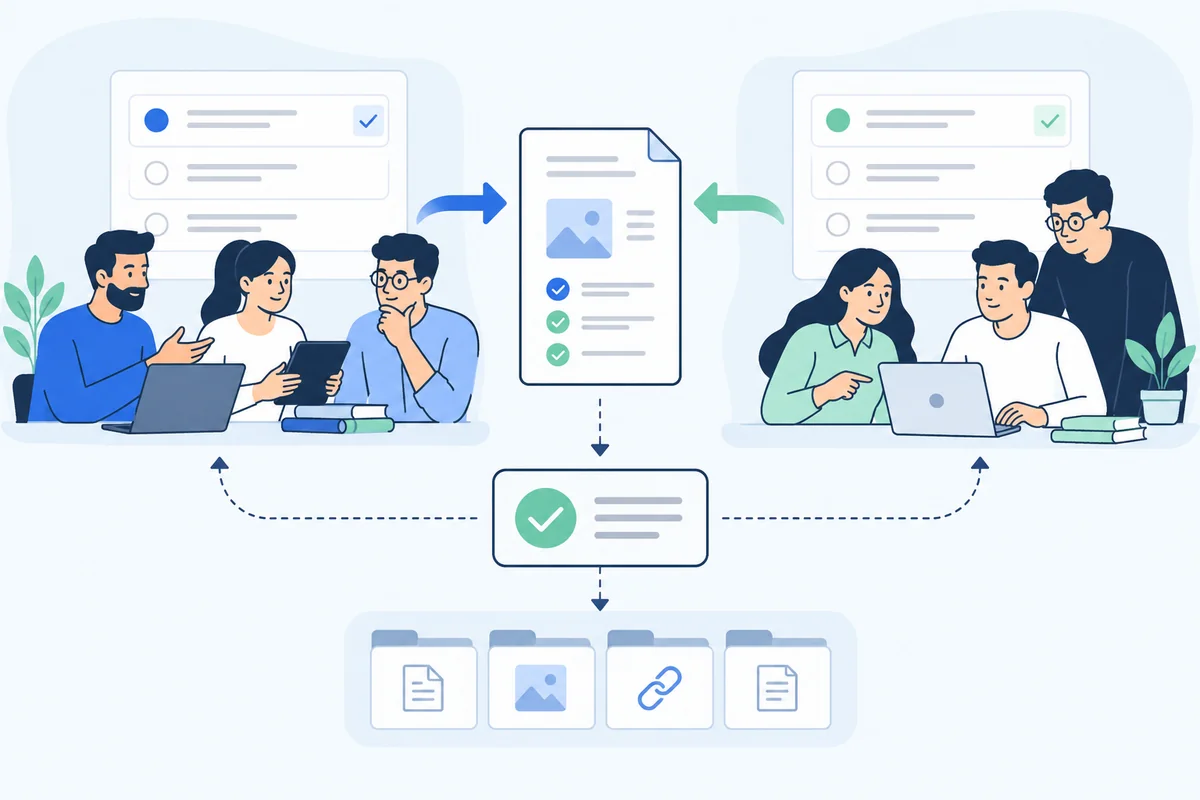
Choosing an agency or an in-house outreach process means deciding who should own research, writing, review, sending, replies, and verification. Compare the scope and evidence you will receive, the work your team must still do, and the cost of maintaining that process.
What you’ll learn
- Define the work before comparing quotes.
- Ask for inspectable evidence and clear responsibilities.
- Include internal review and handoff time in the cost.
Identify the work you actually want to delegate
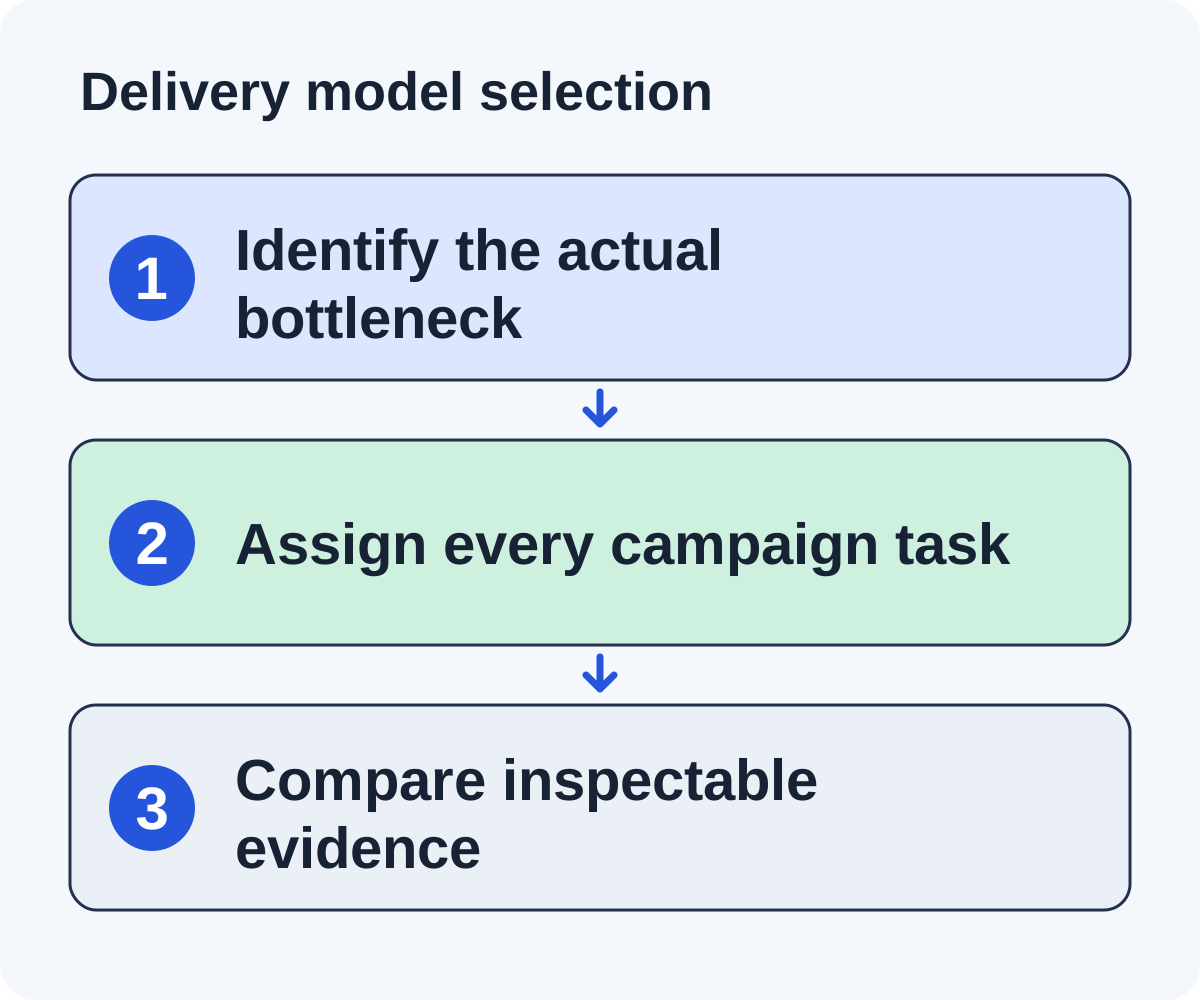
Start with the team’s bottleneck. Is it researching suitable pages, writing from evidence, operating the sender, answering replies, or building the asset? An agency proposal should address the missing capacity rather than bundle every task under an unexplained monthly link count.
Write a responsibility map for the full campaign. Include the internal work that remains: product facts, asset access, approvals, commercial decisions, and oversight of reporting. Even a comprehensive service needs an internal owner who can answer questions and preserve organizational boundaries.
Compare three models against that map. An agency can provide external execution capacity. An in-house process can provide closer product knowledge and direct control. A hybrid can delegate a defined research or operations task. Each model needs a clear handoff and an owner for exceptions.
Separate earned editorial outreach from sponsored placement buying or another commercial service. Ask what the provider’s promise means and what evidence supports it. A guaranteed count does not explain the methods, reader context, or disclosure terms.
Use a small pilot to inspect actual work. A sales presentation about process is useful background, but a redacted opportunity record, reviewed draft, and verification record are more concrete evidence of what your team would receive.
Keep contractual and policy decisions with the appropriate people in your organization. A vendor’s workflow does not replace your approved boundaries.
Compare the ownership models
| Model | Potential benefit | Work still needed internally |
|---|---|---|
| Agency-led | External execution capacity and specialist experience | Scope, product facts, approvals, and verification oversight |
| In-house | Direct control and close product knowledge | Research, writing, operations, and staff development |
| Hybrid | Outsource a defined bottleneck | Clear handoffs and ownership across both teams |
These are possibilities to evaluate, not claims that every agency or internal team performs equally well. Ask for a sample of the actual work and the people responsible for it.
A hybrid process can be useful when the team knows its product well but lacks research capacity. It can also fail if nobody owns replies or decisions cross an unclear approval boundary.
Ask an agency for a reviewable example
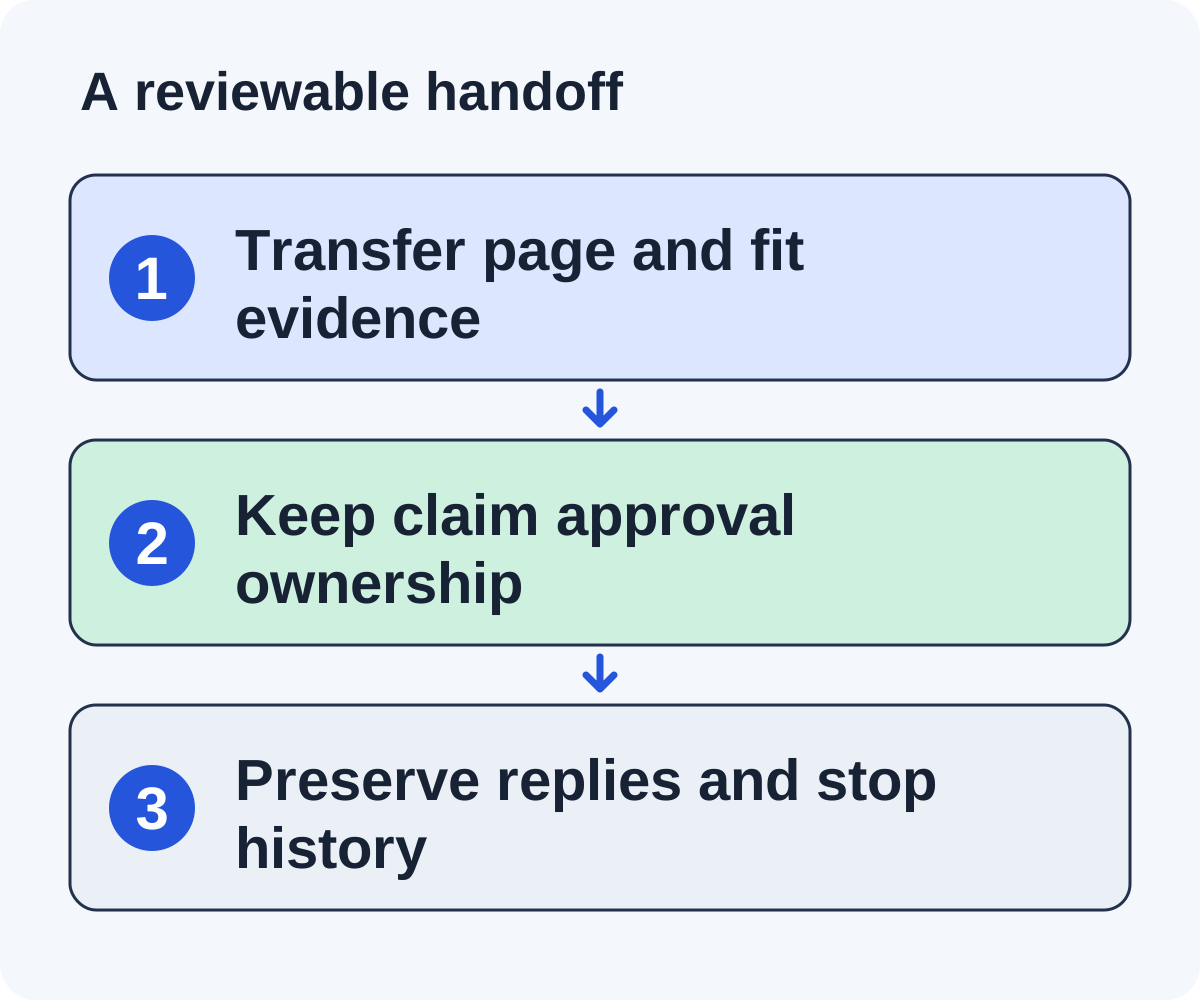
Request a redacted opportunity record showing page fit, proposed contribution, contact evidence, draft, release decision, and verified outcome. Distinguish a genuine case from a mock example and respect confidentiality.
Ask how the agency handles missing evidence, duplicate contacts, declines, opt-outs, and commercial offers. Clarify who owns mailbox access and suppression data when the engagement ends.
For promised placements, ask what counts, how context and destination are checked, and what happens when a reference changes. Don’t accept a positive reply or a scheduled addition as a verified live link.
If the proposed method depends on undisclosed paid links or ranking manipulation, evaluate it under your policy and Google’s spam guidance. A guaranteed count is not evidence of useful editorial quality.
Compare three models on one fictional campaign
Assume the campaign promotes a public SaaS refund worksheet to relevant tutorial publishers. These models are illustrative; they do not describe measured customer results or universal service quality.
| Task | Agency-led | In-house | Hybrid |
|---|---|---|---|
| Asset and product facts | Internal owner supplies and approves | Internal subject owner | Internal subject owner |
| Page research | Agency provides evidence records | Internal researcher | External research support |
| Draft review | Agreed agency and internal approval boundary | Internal reviewer | Internal reviewer checks supplied evidence |
| Replies | Named owner with escalation route | Internal campaign owner | Named internal owner |
| Verification and history | Agency delivers inspectable records | Internal operator | Shared handoff with one record owner |
The hybrid model is useful only if the research handoff preserves why a page fits, not merely an email address. The agency-led model needs a reply and claim escalation path. The in-house model needs enough time to perform the work rather than assign it to an already overloaded founder.
Ask each option to process a similar sample. Inspect rejected candidates as well as accepted ones. If a team cannot explain why an unrelated page was rejected, its accepted list may also be based on superficial signals.
Compare scope and quality before price. A quote including asset creation and reply handling is not equivalent to a prospect list. A low fee can leave considerable internal work. Record those differences so the budget comparison does not hide them.
Compare complete costs with explicit assumptions
Use real quotes and your own labor estimates. Suppose, purely as an illustration, an agency quote is $1,500 monthly and internal coordination takes three hours at an assumed $50 per hour. The defined monthly cost is $1,650 before excluded items.
For an in-house example, a $149 software subscription plus 20 hours at the same assumed rate totals $1,149. These figures are invented planning inputs, not market averages or a claim that one model produces the same outcomes for less.
List exclusions such as asset creation, data tools, mailbox costs, commercial placements, and management time. Compare the same scope and observation period.
Use measured review time and verified outcomes once available. A cheaper plan that leaves replies unmanaged is not equivalent to a complete workflow.
Ask for evidence, ownership, and exit terms
Request a redacted example showing the referring page, relevant section, resource contribution, contact source, released message, conversation state, and live verification. Ask whether it is a genuine case or a demonstration. Respect confidentiality and do not require disclosure of another client’s private data.
Ask how the service handles uncertain evidence, declines, opt-outs, bounced addresses, duplicate publisher contacts, and commercial offers. Who can pause the campaign? Who approves a new product claim? What happens when an editor asks a technical question? These answers reveal the operating boundary more clearly than an overall success claim.
Clarify data ownership and access. Your team should understand who controls mailboxes, publisher history, suppression records, drafts, open conversations, and placement records. Determine what can be exported and how the handoff works when the engagement ends.
Review the proposed method under your organization’s policy. If the service relies on undisclosed paid links or arrangements intended to manipulate rankings, Google’s spam policies are relevant. Do not treat a promised count as evidence that the placements are useful or appropriately handled.
Define what counts as completion. An editor’s positive reply, a scheduled addition, a paid listing, and a verified editorial reference are distinct states. The service report should preserve those distinctions and show the actual page evidence.
Choose a pilot with clear acceptance criteria
Define a small campaign, an asset, fit criteria, approval rules, and the evidence each party must deliver. Set review dates and an exit process before starting.
Inspect rejected prospects as well as accepted ones. This reveals whether the team understands your audience and why a reference would help. Review the actual messages before expanding release autonomy.
Make continuity explicit: open conversations, suppression records, placement URLs, asset maintenance, and ownership should survive a staff or vendor change.
The budget guide supplies an editable cost method. Use the worksheet to compare responsibilities and choose the model your team can actually operate.
Evaluate who owns a difficult editor question
During a fictional pilot, an editor asks whether your public migration checklist covers a specific webhook scenario. The agency’s researcher found the page, but only your internal product team can verify that scope.
Check the operating agreement. The agency can preserve the question and prepare a reply draft from current documentation. The internal subject owner should confirm whether the scenario is supported. The conversation owner then sends the checked answer in the existing thread.
If nobody owns that handoff, the service is incomplete even if prospect research is strong. Include the coordination time in the cost comparison and define a backup for absences. A promised response date should reflect actual review capacity.
Observe what the agency does when the answer is unknown. A sound process retains uncertainty and requests clarification. An unsupported positive claim creates extra correction work and a misleading editorial proposal.
After the answer, record the decision and update the asset facts if the question exposed unclear public scope. If the resource does not fit, close the request rather than promising an unbuilt feature to preserve a placement target.
This case tests more than writing quality. It tests evidence preservation, escalation, authority, and continuity. Use it to compare agency, internal, and hybrid workflows against the same complete task rather than only their ability to produce an initial pitch.
Run a pilot and preserve continuity
Document the asset, audience, fit gates, exclusions, approval rules, reporting fields, and observation period. Agree on a review sample and the evidence each party will deliver. The pilot should test the process, including rejected opportunities and unresolved conversations, rather than only showcase the best placement.
Measure internal coordination time alongside external fees. If an agency saves research time but requires extensive correction of product claims, include that review in the cost. If an in-house process misses replies, include the capacity needed to complete conversations before calling it cheaper.
At the review, identify the bottleneck and choose a specific next step: revise the brief, improve the asset, change research criteria, clarify approvals, or increase a task’s capacity. Do not automatically expand the contract or send volume because the pilot created a large list.
When is a hybrid model sensible?
When a defined task can be handed off with evidence and your team can reliably own the rest. For example, external page research can support internal product review and replies. An unclear split across two sending queues can create more risk and work.
What should survive a provider change?
Open conversations, decline and suppression history, released messages, verified placement URLs, asset maintenance responsibilities, and the source of important claims. Test an export and handoff before ending the engagement, so a new team does not restart already-closed requests.
Put it to work
Use the companion worksheet to apply the decisions in this guide to your own campaign.
Download the worksheet (.txt)Sources and further reading
See what is worth pitching for your site.
Linkade finds relevant pages and writes pitches from their content. Add your domain and inspect prospects before choosing a paid plan.
Start free