AI Link Building: What to Automate and What to Review
By Jake10 min read
On this page
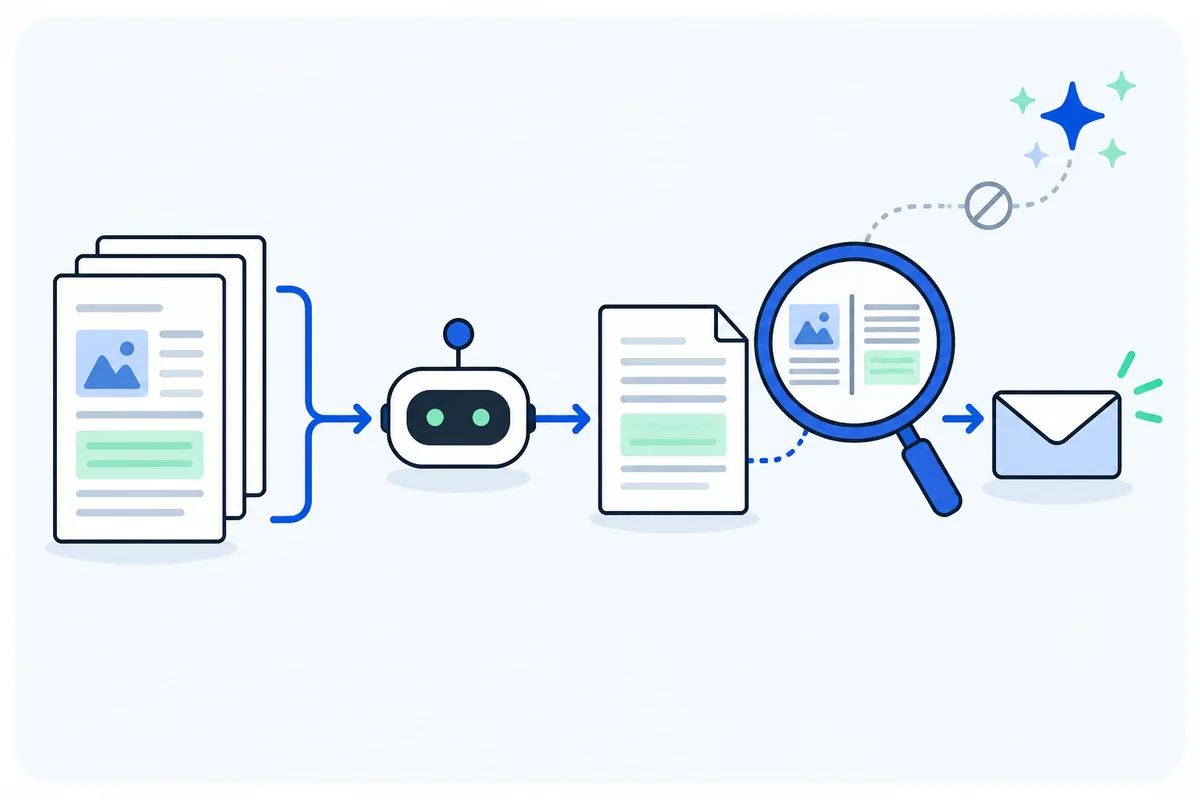
AI can help research pages, summarize evidence, and draft link outreach. It can also turn missing information into a confident sentence. The useful boundary is simple: automate work that can be checked against sources, and keep editorial fit, product truth, and sending decisions explicit.
What you’ll learn
- Assign automation to tasks with inspectable inputs and outputs.
- Reject unsupported page and product claims.
- Test stop conditions before automatic sending.
Break the workflow into separate tasks
“AI link building” can describe several different jobs. Discovery finds candidate URLs. Qualification evaluates fit. Contact research identifies an editorial role. Drafting turns evidence into a request. Sending releases the message. Reply handling manages the conversation.
Do not assume that a tool capable of drafting also handles every later task correctly. Evaluate each boundary separately. You need to know what evidence enters the task, what result leaves it, and how a failure is represented.
For example, a missing contact should remain a missing contact. It should not become a guessed executive address. A page that cannot be fetched should be flagged for review rather than described as if the system read it.
Specify the evidence packet and draft contract
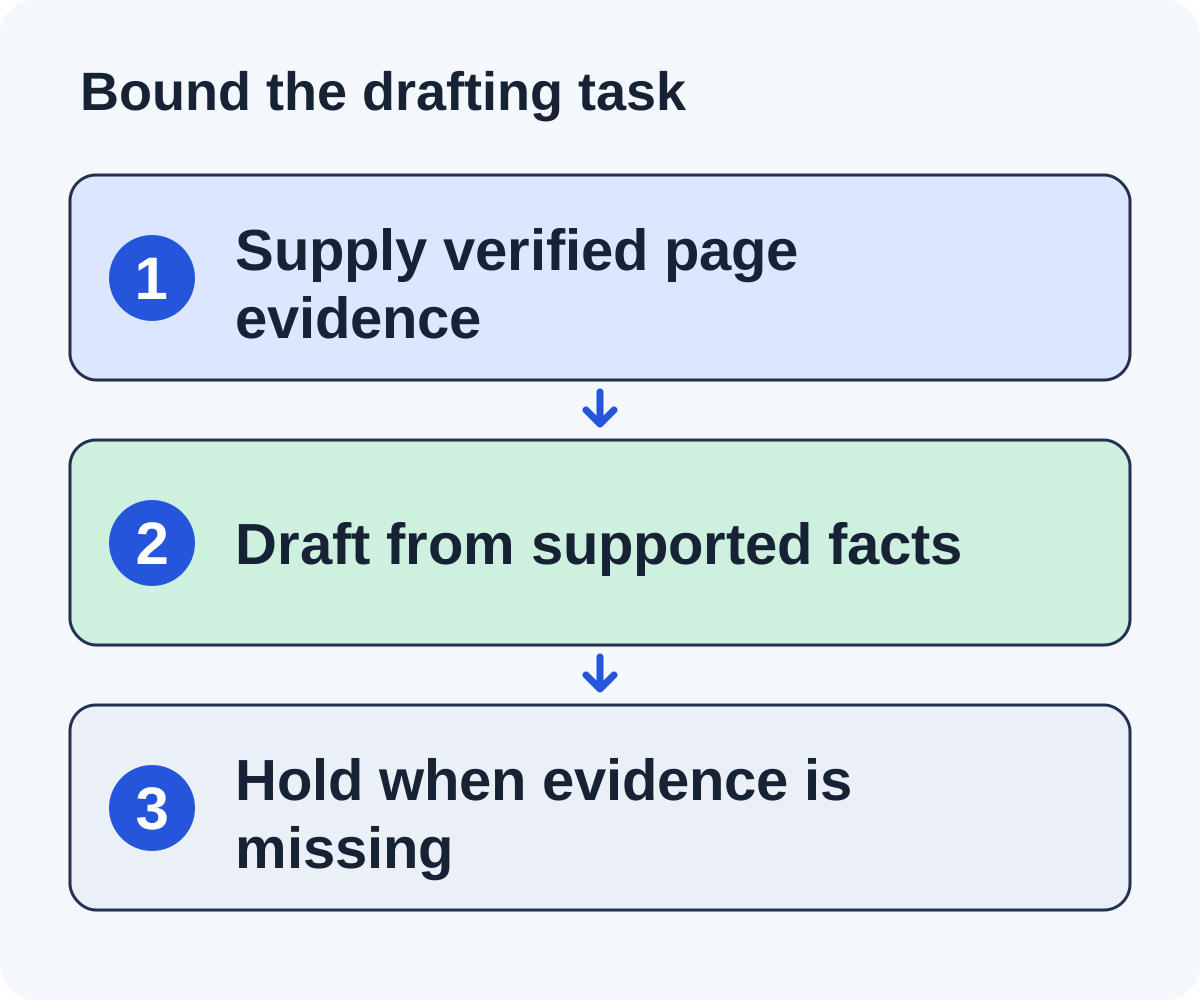
Give a drafting system a bounded job. The inputs should distinguish publisher evidence from your product facts so that the model cannot quietly treat a desired claim as an observed fact.
Publisher evidence
Provide the exact page URL, title, relevant section, a short observation, and the date checked. Add the known editorial format and contact role when supported. Mark uncertainty explicitly: “current maintainer unknown” is an unresolved field, not permission to invent an editor.
Resource evidence
Provide the public destination, the contribution it actually contains, and any limits. A worksheet with one worked calculation is different from a research dataset. Keep unreleased features and hoped-for results outside the supported fact set.
Output contract
Ask for two outputs. The first is a research brief with the proposed fit, one supported observation, and one contribution. The second is a short first email that names the site or a topic it covers, discloses the sender’s relationship accurately, and asks whether the publisher would be open to a guest post or a link suggestion. The email carries no link; the observation and contribution wait for the reply after a yes. Require a hold state when the contribution or contact responsibility cannot be supported. A polished email is not the only acceptable output; “needs review” can be the correct result.
A practical instruction might read: “Draft from these facts only. Do not invent compliments, readership, traffic, product features, existing relationships, or outcomes. If the evidence does not establish a useful addition, return the missing requirement.” Then check whether the actual system follows the instruction on difficult cases.
Keep the evidence references with the draft. The reviewer needs to open the source and compare a sentence with its support without reconstructing the entire research process.
Give the model a bounded evidence packet
A useful drafting packet contains the prospect page URL and relevant section, a short factual observation, the target resource, verified product claims, and the allowed request. Include an explicit instruction to leave unsupported details out.
Keep source text separate from operational instructions. A web page may contain promotional claims or irrelevant text; that material is evidence to evaluate, not permission to change your campaign rules.
Ask for the source of each factual sentence. If the model cannot point to the page or product evidence, remove or investigate the claim. This is a review method, not a guarantee that an AI system will never make an error.
Refresh evidence when it becomes stale. A draft based on a removed section or retired feature can be wrong even if the model accurately summarized the old material.
Rewrite an unsupported draft
This fictional draft sounds polished but lacks support:
Your award-winning guide is the industry’s most trusted resource. Our tool doubles customer activation and would be the perfect number-one choice for your list.
Suppose the only verified facts are that the guide has a section on onboarding checklists and the product provides a public checklist with a worked first-week example. A grounded first email uses the first fact and keeps the second for later:
Hi, I read your onboarding guide, including the section on checklists. I work at [company], which makes onboarding software. Would you be open to a link suggestion or a short guest post on onboarding? If so, I can send the details.
The rewrite removes an invented award, a popularity claim, a numerical outcome, and a demanded ranking. It also makes the editor’s decision easier: one question they can answer yes or no. If they say yes, the next message describes the public checklist and its worked first-week example and gives the link.
Use the template examples to practice the same evidence-to-sentence check on different request types.
Keep approval and stop rules visible
Before enabling automatic sending, test at least these cases: no page evidence, a conflicting product claim, an unsuitable contact, a previous decline, a reply, a bounce, and an opt-out. Record whether the system pauses, rejects, or escalates each case.
Define who can approve a draft and what changes require another review. A corrected typo may be routine; a new price claim or commercial offer deserves a fresh check.
Linkade runs in Copilot, where you approve each email before it sends, or Autopilot, where it sends emails that match the campaign’s brief without approval. Its sending workflow uses mailbox caps and quiet hours, and replies or opt-outs stop follow-ups. You write every reply yourself. Decide which mode matches your campaign’s evidence quality and review needs. Automatic operation still depends on the product facts and policy you provide.
If a tool cannot show why a message was released, keep sending manual until you can resolve that visibility gap.
Test AI drafting with a deliberately mixed sample
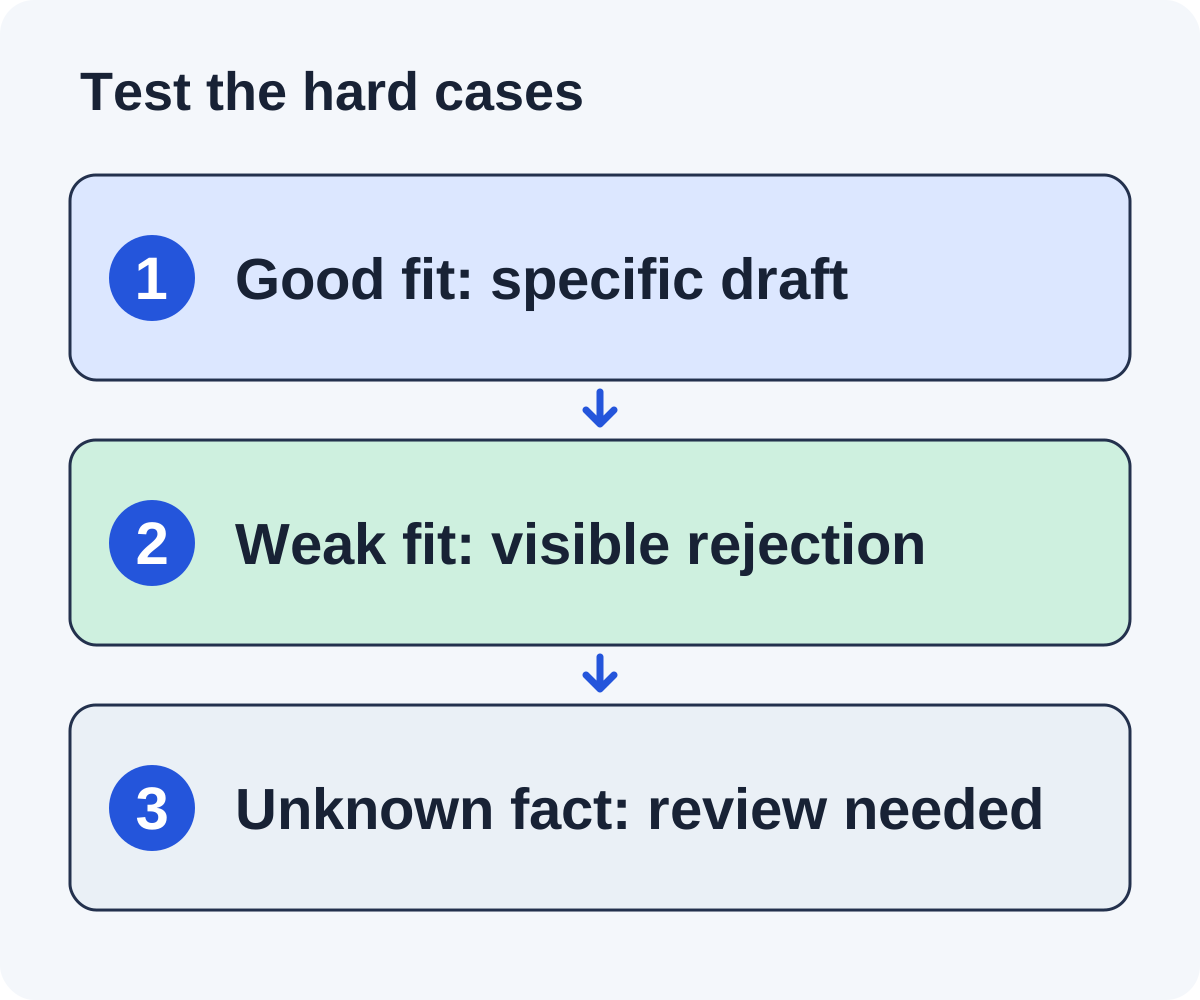
Choose a small sample containing both good and bad opportunities. A test made entirely of obvious fits can conceal the failure that matters most: confident drafts for irrelevant pages. The following five fictional cases illustrate a useful evaluation set.
- Clear tutorial gap: an annual-plan section lacks the calculation your worksheet supplies. Expect a short first email that asks whether the publisher is interested, with the gap kept in the research note for after a yes.
- Contribution already present: the tutorial includes the same complete calculation. Expect rejection or a hold, not a rewritten justification.
- Wrong audience: an enterprise-only roundup excludes your solo-founder product. Expect the mismatch to remain visible.
- Missing ownership: the page fits but no responsible contact is verified. Expect an unresolved contact state.
- Unsupported feature: your internal brief mentions a planned capability that is not released. Expect it to stay out of the pitch.
Score the behavior you need
Record whether the research note preserves the actual observation and accurately describes the contribution, and whether the first email discloses the sender relationship, asks one question, and leaves out the link. Also record whether it stops correctly on missing evidence. A high percentage of grammatically clean drafts tells you little about these requirements.
Investigate one error at a time
If the system invents a claim, inspect which input invited it. If it treats every candidate as qualified, strengthen the acceptance gate rather than simply shortening the prompt. If it chooses the wrong contact, fix the ownership input and verify the result on the same case.
Retain the test packet and observed outputs as a regression sample. When the model, extraction logic, or product brief changes, rerun those exact cases. That comparison reveals a behavior change more clearly than comparing unrelated campaigns.
Evaluate quality on a real sample
Choose a small set of genuine prospects and compare the draft with the actual page. Count supported observations, inaccurate claims, missed fit problems, and editing time. Keep these measurements separate from reply or placement results.
A faster draft that takes longer to verify may not save time. A larger candidate list that mostly fails qualification may not create more useful opportunities. Measure the work your team actually needs to perform.
Do not convert a sample’s result into a general performance promise. If five inspected drafts contain no observed error, report that sample precisely; it does not establish that every future draft is accurate.
The companion worksheet helps you test one task at a time. Start with the prospecting decisions, then add automation where its evidence and failure behavior are clear.
Keep an error log that changes the next draft
Review errors by type so the team can correct the input or boundary that produced them. A useful log records the opportunity, source packet, generated sentence, unsupported claim, correction, and likely cause. “Bad personalization” is too broad to guide a fix.
In a fictional API checklist campaign, an assistant’s research note says that the prospect tutorial has no rollback section. The section exists under “Recovery.” Record a missed-page-context error and improve how the evidence packet identifies existing coverage. Do not merely replace the adjective in the draft.
A second draft says the checklist supports webhook migrations, but the asset only covers REST pagination. That is a product-scope error. Add the excluded scenario to the asset facts and require that an incompatible prospect remain under investigation or be rejected.
A third draft claims the sender has followed the author’s work for years. No source supports that relationship. Remove the claim and make relationship facts an explicit field rather than allowing the model to invent conversational warmth.
After updating the inputs, rerun the relevant mixed cases and inspect the result. Keep the correction cost in your evaluation of total effort. A model that drafts quickly can still consume substantial reviewer time.
These are fictional tests, not measured failure rates. The point is to make errors actionable: page coverage needs better context, product claims need bounded facts, and relationship claims need actual evidence. Broader automation should follow demonstrated handling of these cases.
Understand the automation boundaries and operating risks
Can AI replace prospect qualification?
It can help extract observations and propose a fit, but the acceptance decision still needs evidence. Inspect the actual page and resource on a representative sample. A relevance score should preserve the reason for the decision, especially when a required condition fails.
Can AI invent a better personalized opening?
It can reorganize real information into clear prose. It should not invent a relationship, a compliment about an unread article, or a capability that does not exist. Personalization quality depends on the supported observation, not the sophistication of the sentence.
How should you handle changed pages?
Keep the evidence date and recheck before sending when the campaign depends on a specific section. If the section changes, update the proposed contribution and regenerate the draft. An old observation can produce an accurate-looking but obsolete request.
What should happen when the model is uncertain?
Use an explicit review state with a specific missing fact. “Unable to confirm that the worksheet adds an example” tells the reviewer what to inspect. Treating uncertainty as acceptance encourages unsupported messages.
Which tasks are easier to automate?
Collecting candidate URLs, preserving source notes, preparing draft structures, and updating recorded workflow states can be bounded and checked. Negotiating a commercial arrangement or responding to a substantive editorial question requires the actual context and decision owner.
What should stop an automatic sequence?
A reply, opt-out, decline, delivery failure, invalid destination, or failed approval gate should trigger the appropriate stop or review behavior. Test those events using a nonproduction exercise before trusting a campaign to handle them.
Start with limited autonomy, inspect error categories, and expand only the tasks that meet your acceptance criteria. Improving the evidence inputs often matters more than making the prompt sound more authoritative.
Put it to work
Use the companion worksheet to apply the decisions in this guide to your own campaign.
Download the worksheet (.txt)See what is worth pitching for your site.
Linkade finds relevant pages and writes pitches from their content. Add your domain and inspect prospects before choosing a paid plan.
Start free