Link Building Outreach Templates, With Page-Specific Examples
By Jake11 min read
On this page
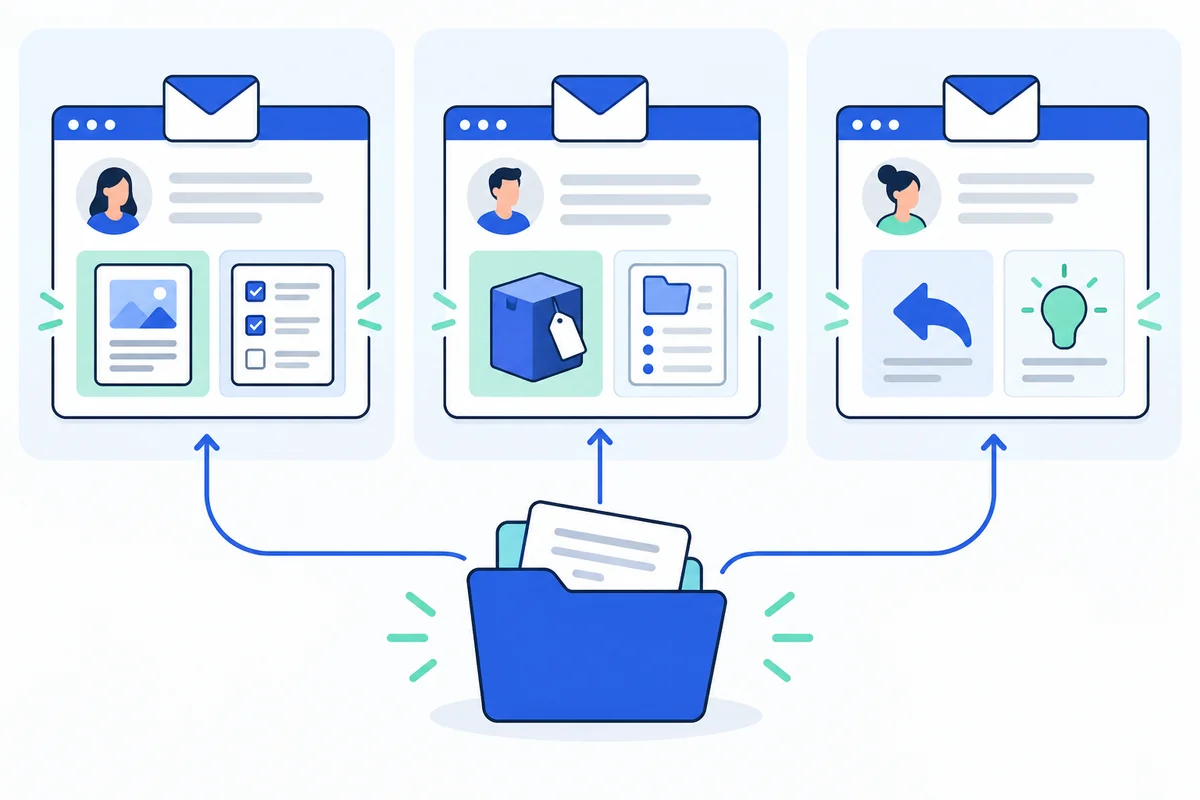
An outreach template gives a message a structure. Page evidence gives it a reason to exist. Use these examples as editable starting points for first emails that ask whether a publisher is interested, the message you send after they say yes, and follow-ups. The first email carries no link. Replace every assumed fact with something you actually checked.
What you’ll learn
- Separate reusable structure from page-specific facts.
- Adapt three examples to different editorial situations.
- Remove unsupported praise, urgency, and performance claims.
Collect the facts before filling the template
You need four inputs: the recipient’s editorial role, the prospect page and relevant section, the resource you are suggesting, and the contribution that resource makes. Keep them beside the draft so the reviewer can check each sentence.
The examples below use fictional editors and resources. They are writing exercises, not messages from a successful campaign. No response-rate claim accompanies them because a sample message does not establish performance.
Keep the greeting, identification, and question reusable. Rewrite the line about their site for each prospect, and write the observation and contribution fresh in the message after they say yes. If only the recipient name changes, you have not shown why you chose that particular site.
Build an evidence-to-sentence map
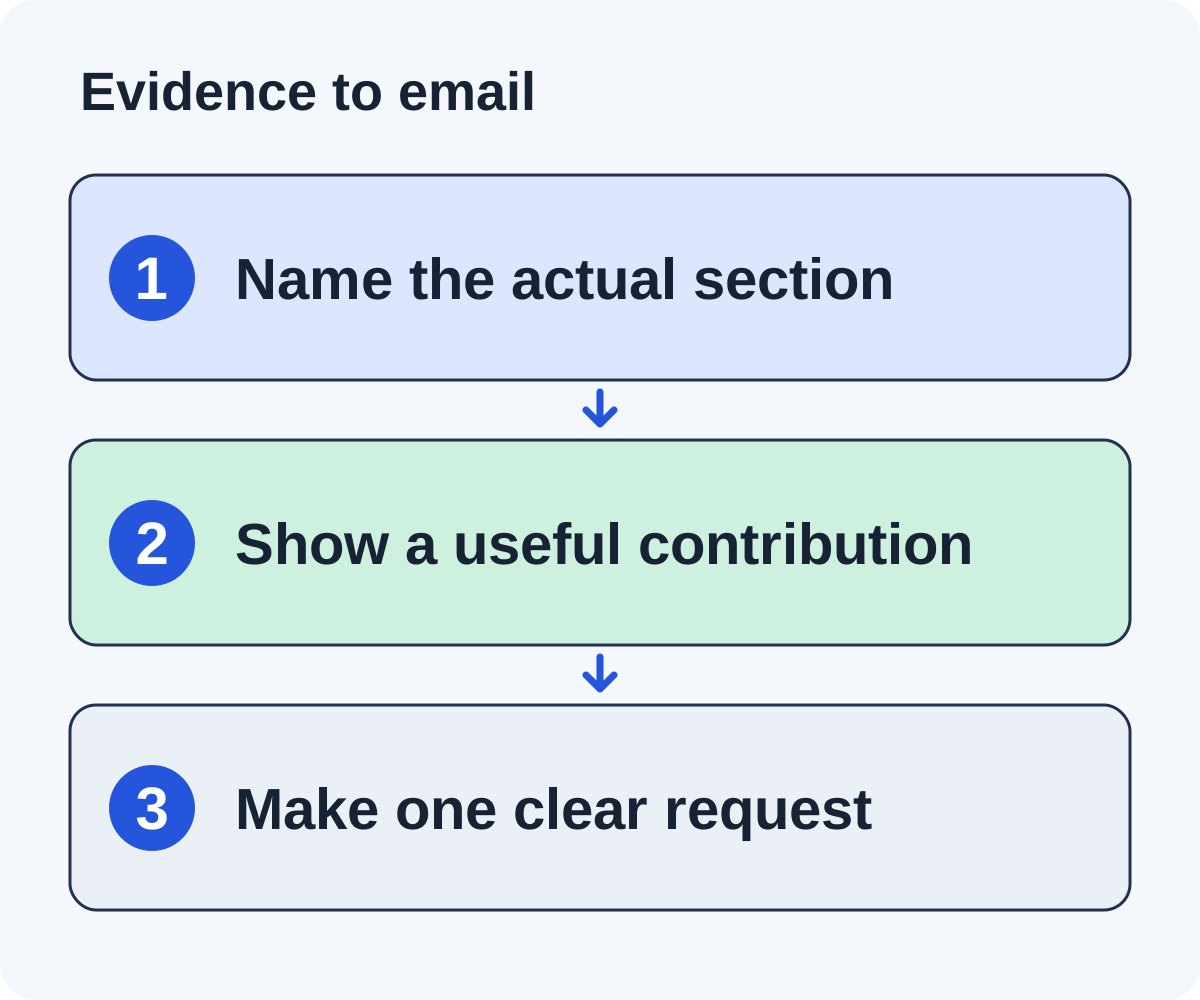
A template works when its variable fields contain facts the recipient can verify. Create a short evidence note before opening the email draft. The note should include the target page, the specific section or list category, the contribution, and the destination URL.
Consider a fictional public subscription calculator. The target tutorial explains monthly plans but has no annual-plan example. The calculator has a worked annual calculation with assumptions visible. Your map connects “annual section lacks an example” to “our resource supplies that example,” rather than connecting “large SaaS audience” to “please link to us.”
Translate the note into four sentences
- Context: name their site or the topic they cover. This goes in the first email.
- Question: ask whether they would be open to a guest post or a link suggestion. This also goes in the first email.
- Observation: describe the supported reader need, after they say yes.
- Contribution: explain what the destination adds and give its URL, after they say yes.
The first email has no link and does not tell the editor what their page is missing. Those details wait for the reply to an interested editor. Keep your relationship to the resource clear. If you work for the company, say so. A template should not pretend that you are an unaffiliated reader who happened to discover the asset.
Use optional fields deliberately. A reference to a section is useful when the section genuinely explains the fit. A compliment is not required. An attachment is not required. A request for a call is usually a different, larger task than asking an editor to inspect a public resource.
If a variable cannot be supported, leave the message in review. Replacing missing evidence with an enthusiastic adjective makes the email fluent but does not make it accurate.
Template one: suggest a useful resource
Subject: Your MRR guide

Hi Alex,

I read your MRR guide, including the part on annual
subscriptions. I’m Sam from a small subscription analytics
company.

Would you be open to a link suggestion or a short guest post
on SaaS revenue metrics? If so, I can send the details.

Sam
[accurate company and reply details]
After they say yes: the second message carries the detail and the link.
Thanks, Alex. The worksheet is here: [real resource URL].

It adds a worked example for a refund partway through an
annual plan, which could sit beside your annual-subscriptions
section. Happy to send the formula details if you want to
review them.

Sam
Evidence needed: The page really has that section, and the worksheet really handles the refund scenario. “Public” means the promised material can be accessed in the way the message describes.
Why the first email stays short: It names their guide and asks one question, with no link and no list of what the page lacks. The second message carries the location and the reader problem, so the editor can decide whether the calculation is useful without accepting a vague claim about the company.
If your resource only explains basic MRR, remove the refund claim and find a page where that simpler contribution fits.
Template two: request product consideration
Subject: Your onboarding tools list

Hi Morgan,

I read your roundup of onboarding tools, which groups them by
the team they serve. I work on [product], an onboarding tool
for [specific audience].

Would you be open to a suggestion for that list? If so, I can
send the details.

Sam
After they say yes: the second message names the section and gives the product page.
Thanks, Morgan. The self-serve SaaS section looks like the
closest fit: [product] offers [verified capability] for
[specific audience]. The public product details are here:
[real product URL].

I can share a test account or answer questions about the
workflow if useful.

Sam
Evidence needed: The roundup has the claimed category, your audience fits it, and the capability exists in the current product. Offering a test account is appropriate only if you can actually provide one.
Ask for consideration rather than demanding inclusion, a ranking position, or a specific anchor. Disclose your connection to the product. If the editor has submission instructions, use those instead of imposing your preferred process.
A list already containing an equivalent product may still have a meaningful coverage gap. Explain the distinction in concrete terms. “We are better” is not an editorial criterion.
Template three: add one useful follow-up
Hi Alex,

Following up on my note about your MRR guide. Would you be
open to a link suggestion or a short guest post on that topic?
If it does not fit, no problem.

Sam
Use a follow-up only when it is permitted by your approved policy and no reply, decline, bounce, or opt-out has stopped the sequence. This sample repeats the question in a line rather than inventing a deadline. It still carries no link; the resource and its URL come only after the editor says yes.
Do not send the same follow-up repeatedly. Decide a stop condition before the first message goes out. If an editor responds with a question, answer the question in the existing thread and pause the sequence.
For timing and stopping decisions, use the follow-up guide when it is available.
Compare a generic draft with a useful editorial request
The following drafts are fictional examples. The improved version assumes that its facts have actually been checked.
The generic version
Hi! I love your amazing site. We have the best subscription analytics tool and would love a backlink in your article. It will improve your SEO and our readers will love it. Can you add us?
This draft does not identify a page or explain the reader benefit. “Best” is unsupported, the supposed SEO benefit is speculative, and the request makes the sender’s desired backlink the editor’s job.
A grounded version
Hi Maya, I read your MRR calculation guide, including the section on annual subscriptions. I work at a subscription analytics company. Would you be open to a link suggestion or a short guest post on that topic? Happy to send the details if so.
Naming the guide shows the email was written for this site. The disclosure identifies the sender’s relationship. The single question leaves the decision with the recipient. There is no link and no claim about what the guide is missing. If Maya says yes, the next message describes the partial-refund example and gives the URL so she can inspect it.
Adapt it to a product roundup
A product request needs different evidence. If the list compares lightweight tools for solo founders, identify the real use case your product supports and the actual eligibility criterion it meets. Do not reuse the worksheet email and merely swap the topic.
Hi Maya, I read your roundup of subscription tools for solo founders. I’m on the team that builds [product], which supports [verified task]. Would you be open to a suggestion for a future update of that list?
Fill the brackets with specific verified information. Keep the product URL and the [inspectable capability or limit] for the reply after she says yes. If the editor’s list requires a feature you lack, the correct adaptation is to choose a different opportunity.
Review the draft sentence by sentence
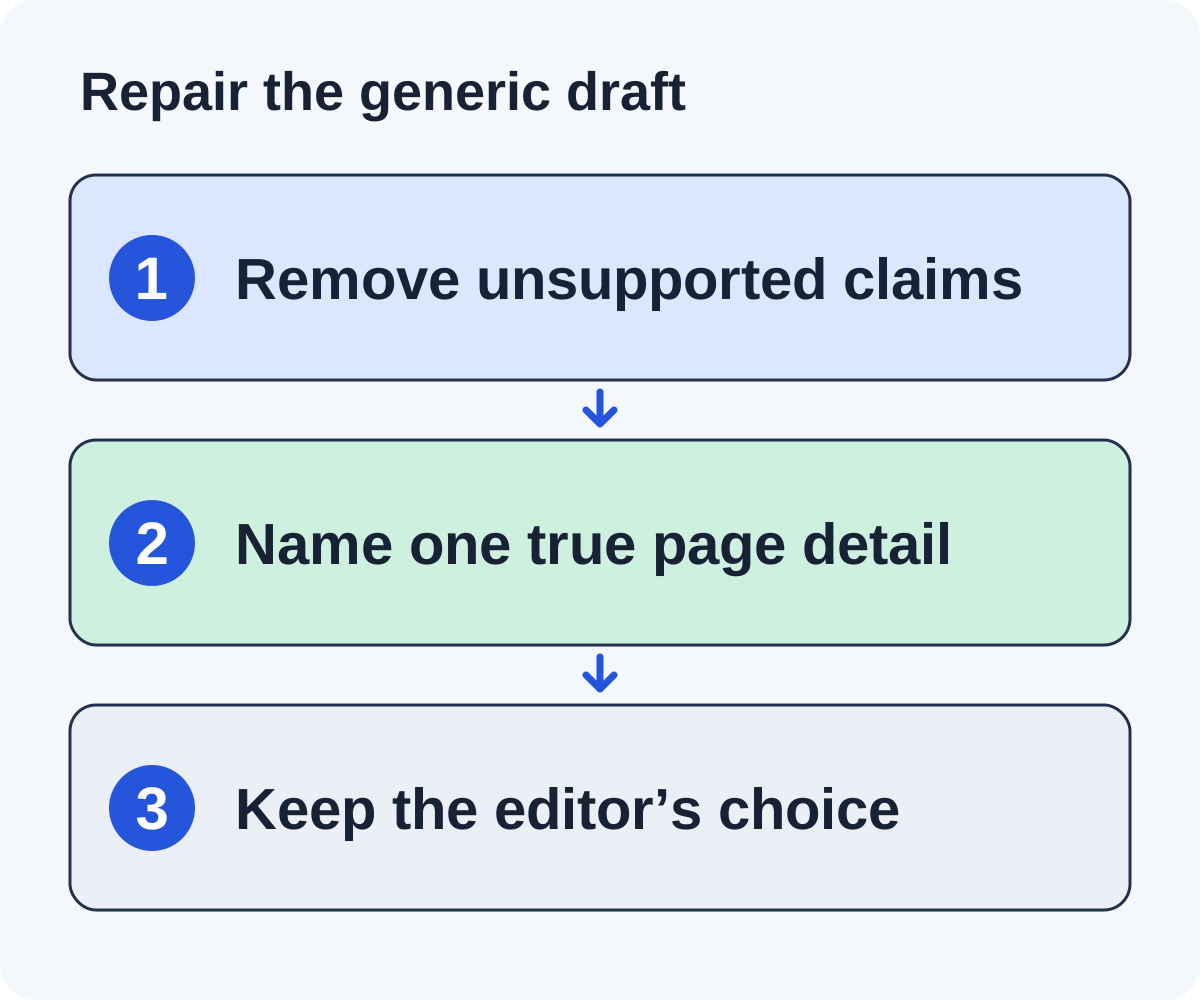
Mark every factual statement with its source. The page observation points to a section; the capability points to documentation or a checked product screen; the sender relationship points to your actual role.
- Replace “I loved your article” with a plain line naming their site or the topic they cover.
- Remove “best,” “proven,” and numerical performance claims unless you can substantiate them.
- Check that the first email carries no link, and that the resource link you send after a yes opens correctly.
- Make the request clear enough to answer in one sentence.
- Confirm that the sender can fulfill anything offered.
Read the message as the editor. Is the question obvious? Can they answer it quickly? Would a polite decline end the conversation? That review is more useful than making every pitch sound enthusiastic.
Use the worksheet to create your own evidence-to-sentence map. The full outreach workflow explains where that review belongs in the campaign.
Adapt the structure to a technical checklist
Consider a fictional public API migration checklist. A developer tutorial discusses updating an integration but does not show rollback verification. That observation tells you the site is worth contacting, but it belongs in the message after a yes, not in the first email. Neither message should borrow a worksheet’s language about calculations.
Subject: Your API migration guide
Hi Riley, I read your migration tutorial on version upgrades. I’m with the team behind [product], a tool for API teams. Would you be open to a link suggestion or a short guest post on migration testing? If so, I can send the details.
After Riley says yes, the second message can say what you found and give the link: the version-upgrade section walks through deployment without a rollback verification step, your public checklist covers deployment and rollback checks for [actual supported scenario], and it is at [checked URL].
Before sending that second message, confirm that the tutorial lacks the step, your checklist really supplies it, and the supported scenario matches. If the page has a rollback section under another heading, the opening is wrong. If your checklist covers another API architecture, the contribution is wrong. If the author does not manage updates, the contact route needs more research.
The reusable elements are the site or topic, your affiliation, and one question in the first email, then the location, observation, and resource contribution after a yes. The subject and wording change with the task. Do not keep a polished template sentence when its underlying fact no longer applies.
Store the filled draft and its evidence map together. A reviewer should be able to check each factual sentence without guessing which template slot produced it. That makes reuse efficient while preserving the context an editor actually needs.
Choose the right subject, follow-up, and stop decision
What should the subject line say?
Keep it plain and specific to their site. Examples include “Your MRR guide” or “Your onboarding tools list.” These are sample descriptions, not tested winning subject lines. Avoid an invented urgent deadline or a fake reply prefix that implies an existing conversation.
How long should the email be?
The first email can be three or four sentences: their site or topic, who you are, and one question about whether they are open to a guest post or a link suggestion. The message after a yes needs enough room to explain the page, contribution, and destination. Read each draft as a busy editor. Removing unsupported background usually makes the message clearer. Do not shorten it so far that the reason for contact disappears.
What can a follow-up add?
Before a reply, very little. A short nudge that repeats the question in a line is enough, and it still carries no link. Once the editor says yes, the next message is where the resource, the specific example, and the URL belong. Do not send more than your policy allows, and stop as soon as anyone replies.
What happens after a reply?
Pause the sequence and answer the actual response. A question about a formula needs an explanation of that formula. A wrong-contact response needs a verified handoff. A decline or opt-out closes that request. Do not send the next scheduled reminder as if no conversation happened.
Can I use the same template across many prospects?
You can reuse the structure while verifying each page-specific field. Keep a review sample and inspect whether the evidence supports each sentence. If the same observation appears in every draft, confirm it is a real recurring gap rather than a default invented by the template.
When should a message stay unsent?
When the page has no relevant place for the resource, the destination fails its promise, the contact is unsuitable, or a material claim is unverified. Templates reduce writing effort; they do not remove the need for an editorial reason to contact someone.
Retain the source note beside the approved message. When another teammate handles the reply, they should be able to see why the pitch was made and what the company can actually supply.
Put it to work
Use the companion worksheet to apply the decisions in this guide to your own campaign.
Download the worksheet (.txt)See what is worth pitching for your site.
Linkade finds relevant pages and writes pitches from their content. Add your domain and inspect prospects before choosing a paid plan.
Start free