How to Personalize a Link-Building Email Using Page Evidence
By Jake10 min read
On this page
Personalizing a link-building email means writing to this site for a reason you can name. A first name and a compliment do not establish that fit. Use a checked observation to decide whether to write, keep the first email to a line about their site and one question about whether they are interested, and save the observation and contribution for the message after they say yes.

What you’ll learn
- Use a page observation to decide whether to write at all.
- Map every factual sentence to evidence.
- Keep the first email to one question, with no link.
Find an observation that matters
Read the section where the reference could belong. Look for a missing example, a relevant resource category, an outdated factual detail, or an audience need your asset can address.
The observation must affect the request. “You published this article in June” may be true, but it rarely explains why your resource helps. “Your migration checklist covers exporting data but not verifying record counts afterward” identifies a contribution to evaluate.
Confirm that your asset actually supplies the missing step. If your checklist also omits verification, the observation is accurate but the pitch is unsupported.
Record the page URL, section heading, observation, and date. If you cannot locate the observation again, do not write as though it is certain.
Research a page detail that changes the request
Personalization begins with an observation that determines whether the proposed contribution belongs on the page. Naming a person or repeating the article title can help establish context, but it does not explain why the editor should consider a reference.
Inspect the relevant section
Find where a reader might need your resource. For a calculator, look for a calculation that is explained but not worked through. For a checklist, look for an action described without a reusable sequence. For a product, inspect the category and selection criteria.
Test the missing contribution
Open the destination and confirm it supplies the promised material. A short worksheet that lacks the edge case is not a solution to the missing example. Keep the exact contribution narrow enough to verify.
Write the observation neutrally
“The annual-plan section explains dividing by twelve but does not include a refund example” describes a visible state. “Your readers are struggling” invents reader behavior. “Your article needs improvement” also makes a broader judgment than the evidence supports.
Record the observation date and a short section reference. If the page changes before sending, recheck the claim. A precise observation can become obsolete, and an accurate-looking email can then misrepresent the current page.
Stop if the contribution is already covered or the audience does not match. Adding more personal details to the opening will not repair that editorial mismatch.
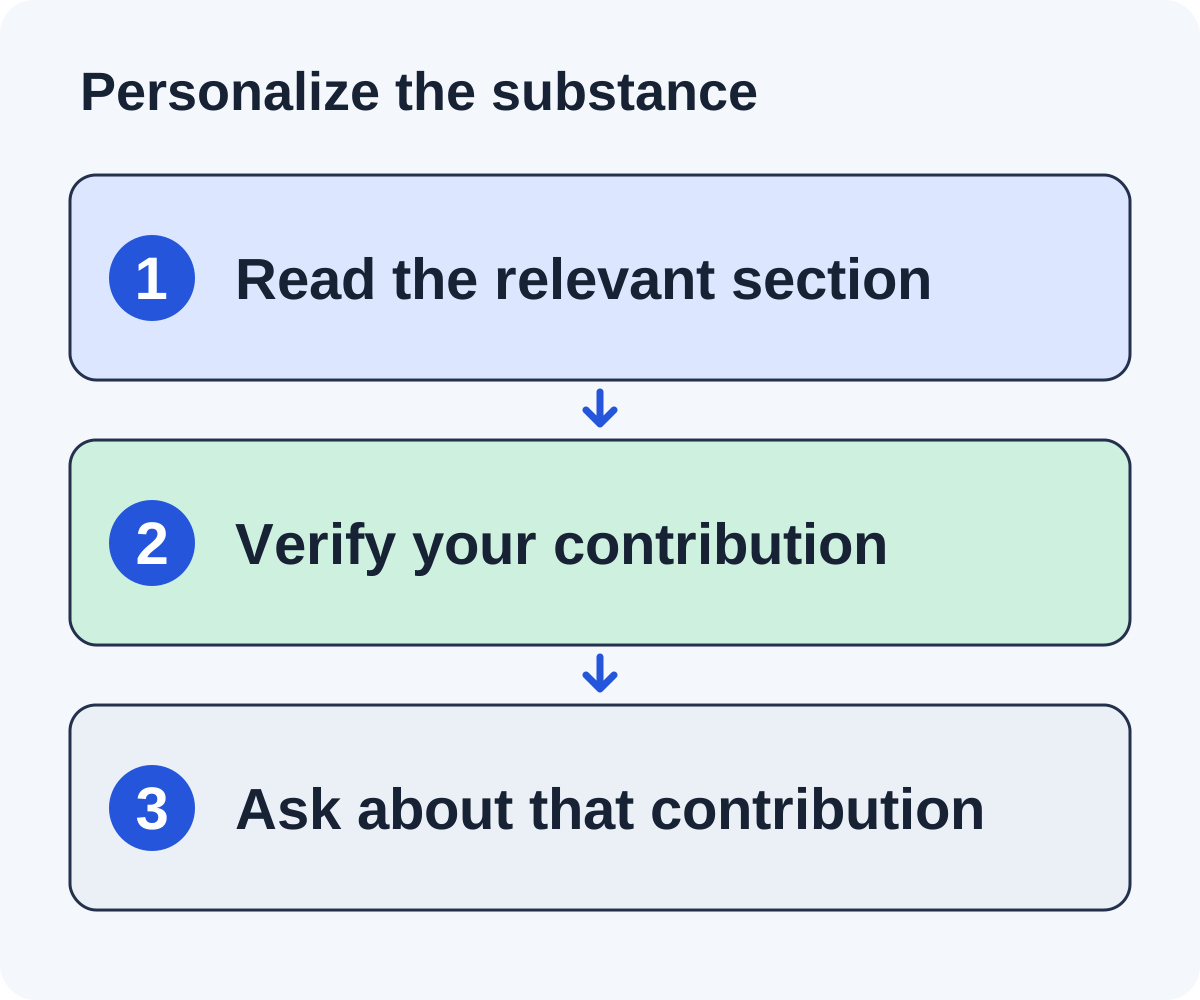
Connect the observation to the contribution
Use a two-column note before writing: what the page does, and what your resource adds. The connection should be intelligible without knowing your company.
Here is a fictional example. A tutorial explains importing subscribers into a new billing system. Your public migration checklist includes a reconciliation step that compares subscriber totals before and after import. That is a specific contribution for the tutorial’s verification section.
A weak connection would be offering your broad homepage because your company also works with subscriptions. The category overlaps, but the proposed destination does not complete the reader’s task.
When the destination is a product page, describe a verified capability and the audience it serves. Do not switch from an editorial suggestion into an unsupported superiority claim.
Annotate a personalized pitch one sentence at a time
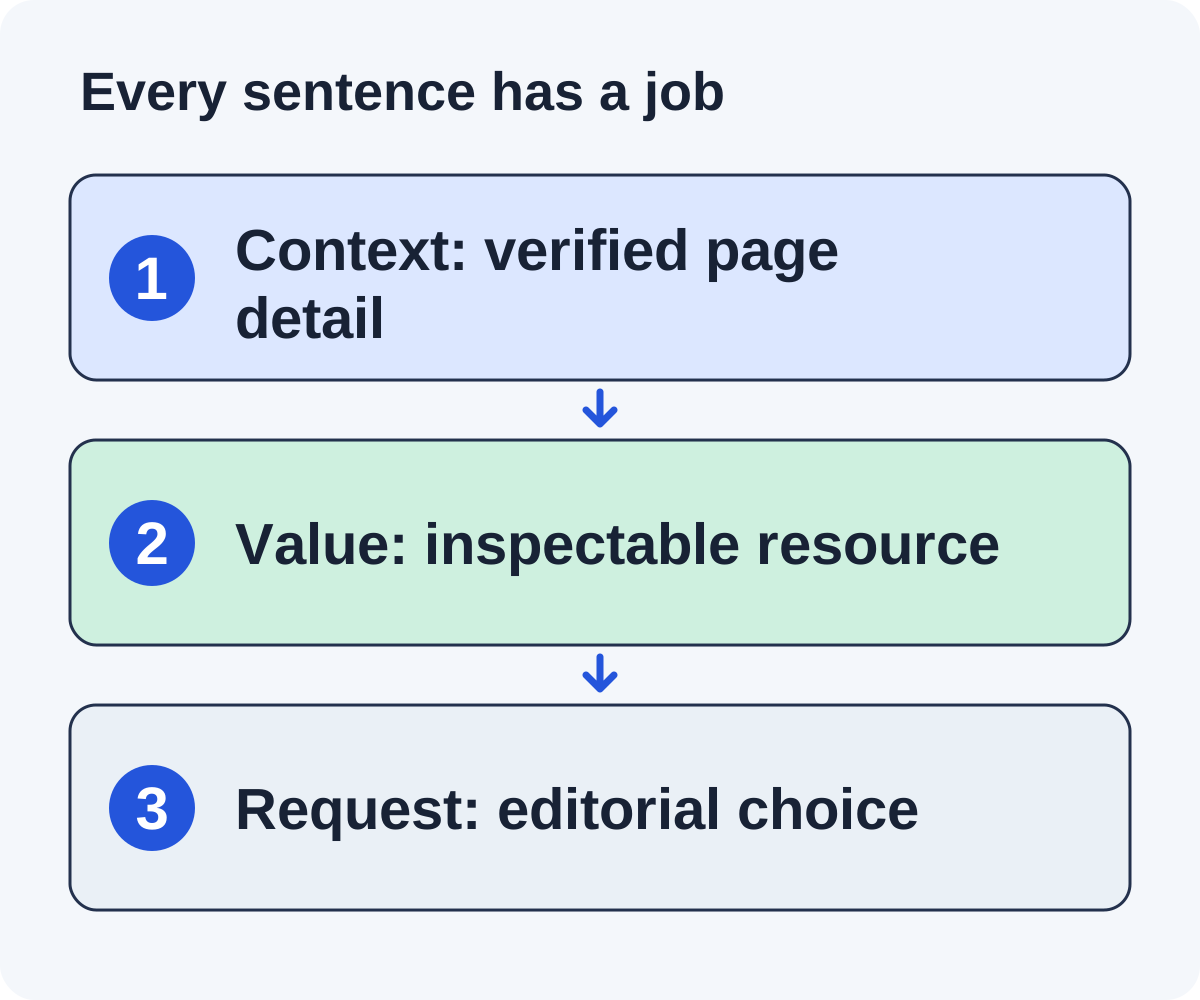
These fictional messages assume a real page observation and a verified public worksheet. They demonstrate sentence roles rather than a proven winning template. The first email asks; the second goes only to an editor who said yes.
Hi Jordan, I read your guide to annual SaaS plans, including the “Revenue examples” section. I work with a team that makes SaaS finance tools. Would you be open to a link suggestion or a short guest post on that topic? Happy to send the details if so.
After Jordan says yes:
Thanks, Jordan. We made a public worksheet that adds a partial-refund example with the assumptions visible: [URL]. It could sit alongside the “Revenue examples” section. I can clarify the formula if needed.
The context sentence
The opening names the actual subject and section. Check that the wording matches the page. If you cannot find the section, remove or correct the claim instead of hoping the editor will overlook it.
The contribution sentence
In the message after a yes, the first sentence describes what the resource supplies. Confirm that the example exists and is understandable. “Adds a partial-refund example” is a supported feature claim; “will transform your readers’ business” is an unsupported outcome claim.
The request sentence
The first email’s question is small enough to answer: is the editor open to a guest post or a link suggestion? It carries no link and asks for no change to the page. It does not ask for a call, backlink exchange, or particular keyword anchor. The editor retains the choice of whether and how to use the resource.
The relationship sentence
The sender identifies their connection to the asset. The offer to clarify the formula must be something the sender can actually fulfill. A promise of custom analysis or an expert review needs a real owner and the necessary capacity.
Remove the decorative material
A copied author biography, generic praise, or speculation about the publication’s traffic does not help assess the proposed contribution. Keep details that change the editorial decision; remove details whose only role is to signal that you looked at the website.
| Draft sentence | Problem | Supported replacement |
|---|---|---|
| I’m a longtime reader of your brilliant blog. | Relationship and praise may be invented. | Your migration guide includes an import checklist. |
| Our tool is the best solution for everyone. | No defined audience or substantiation. | After a yes: our public checklist adds a record-count reconciliation step. |
| You should put us first in the list. | Demands an editorial outcome. | Would you be open to a link suggestion for your migration guide? |
The first email can be short because the research has already resolved the relevance. Do not paste your internal notes into it. After a yes, include only the observation and contribution the editor needs to make a decision.
Use a complete, restrained message
Hi Morgan, I read your subscriber-migration guide, including the import checklist. I’m with a team that builds billing tools. Would you be open to a link suggestion or a short guest post on data migration? If so, I can send the details.
After Morgan says yes, the next message can say that your public checklist adds a record-count reconciliation step after import, suggest the verification section, give the link at [real URL], and offer the example calculation if helpful.
Replace the fictional details before use. The first email identifies the page, the sender’s relationship, and one question; the URL appears only in the reply after a yes. Neither message pretends that the editor has used the product or endorsed the company.
A subject line can name their guide or the topic. Avoid fake replies, false urgency, and misleading familiarity. Match the subject to the content of the message.
Keep optional offers realistic. If you cannot provide a test account, data source, or explanation, do not promise one to make the pitch sound stronger.
Know when personalization cannot repair the fit
Skip a page whose audience does not match your resource, whose existing material already covers the contribution, or whose submission rules you cannot follow. Writing a more elaborate compliment will not resolve those problems.
Review new drafts against the prospecting criteria. If many require invented connections, the candidate list or destination asset needs work.
For repeated request types, reuse the structure from the template guide, while rewriting the observation and contribution. Preserve evidence beside the draft so another reviewer can check it.
Your worksheet is complete when each factual sentence has a source and the proposed addition has a clear location. That is a more useful definition of personalization than the number of customized words.
Use the same evidence method for a different editorial job
A fictional operations software team has a public project-handoff checklist. A small-team guide explains how to assign a project owner but does not show a completed handoff record. The useful observation concerns the missing example, not the author’s biography or a generic compliment about the guide.
Hi Devon, I read your project-handoff guide, including the ownership section. I’m with a team that makes operations software for small teams. Would you be open to a link suggestion or a short guest post on project handoffs? If so, I can send the details.
After Devon says yes, the second message can carry the observation and the link: the ownership section explains who takes over but has no completed handoff example, your public checklist has a fictional filled record showing responsibilities, open work, and verification, and it is at [checked URL].
Audit both messages. The first email’s opening line must match the page, its second sentence accurately discloses the sender’s relationship, and its question makes one optional request. The second message needs a real page observation and a real asset containing the described record.
Now imagine the guide already has a complete example. The personalization method should produce a rejection or a different checked contribution, not a more flattering opening. If the asset requires a demo request, the phrase “public checklist” must change or access must be corrected.
Personalization is the fit reasoning made visible. In the first email it shows why you chose this site; after a yes, it explains why this resource belongs in this section. Details that do not change that reasoning usually add length without helping the editor assess the request.
Handle the cases where personalization breaks down
The page has no obvious gap
Do not invent one. You might have a genuinely different resource format, clearer example, or relevant product category, but you still need a supported contribution. If nothing adds value in this context, reject the opportunity.
You only know the publication’s general topic
Open the exact page and inspect the actual section. “Writes about SaaS” is too broad to support a calculation pitch. The destination needs a place in the page, not merely a shared industry label.
The asset uses a different definition
Resolve the mismatch before sending. A retention tutorial and your calculator might define a cohort differently. Explain the assumption or choose a resource that matches. Do not imply two examples are interchangeable because they use the same acronym.
The recipient is a team inbox
Use a suitable greeting and identify the page clearly. A verified role and a useful request can be sufficient; you do not need to guess a person’s name. Respect the publication’s documented submission route.
A drafting model adds enthusiastic claims
Compare every material sentence with the evidence note. Remove unverified reader behavior, traffic, rankings, outcomes, and relationships. Keep a review state when the available facts do not support an accurate request.
Should every pitch have a different structure?
No. A consistent structure can make review easier. What must differ is the supported observation and contribution when the editorial need differs. Rewriting the same generic request in twenty different voices does not create twenty relevant opportunities.
How do you review personalization at scale?
Review examples from different discovery routes and error categories. Check both accepted and rejected pages. If every candidate gets an equally confident pitch, inspect whether the qualification gate is actually influencing the draft.
The finished record should include the source observation, resource feature, proposed request, and date checked. Keep it attached to the conversation so a reply owner can answer the editor’s actual question.
Put it to work
Use the companion worksheet to apply the decisions in this guide to your own campaign.
Download the worksheet (.txt)See what is worth pitching for your site.
Linkade finds relevant pages and writes pitches from their content. Add your domain and inspect prospects before choosing a paid plan.
Start free