Unlinked Brand Mentions: Find and Evaluate Reclamation Opportunities
By Jake10 min read
On this page
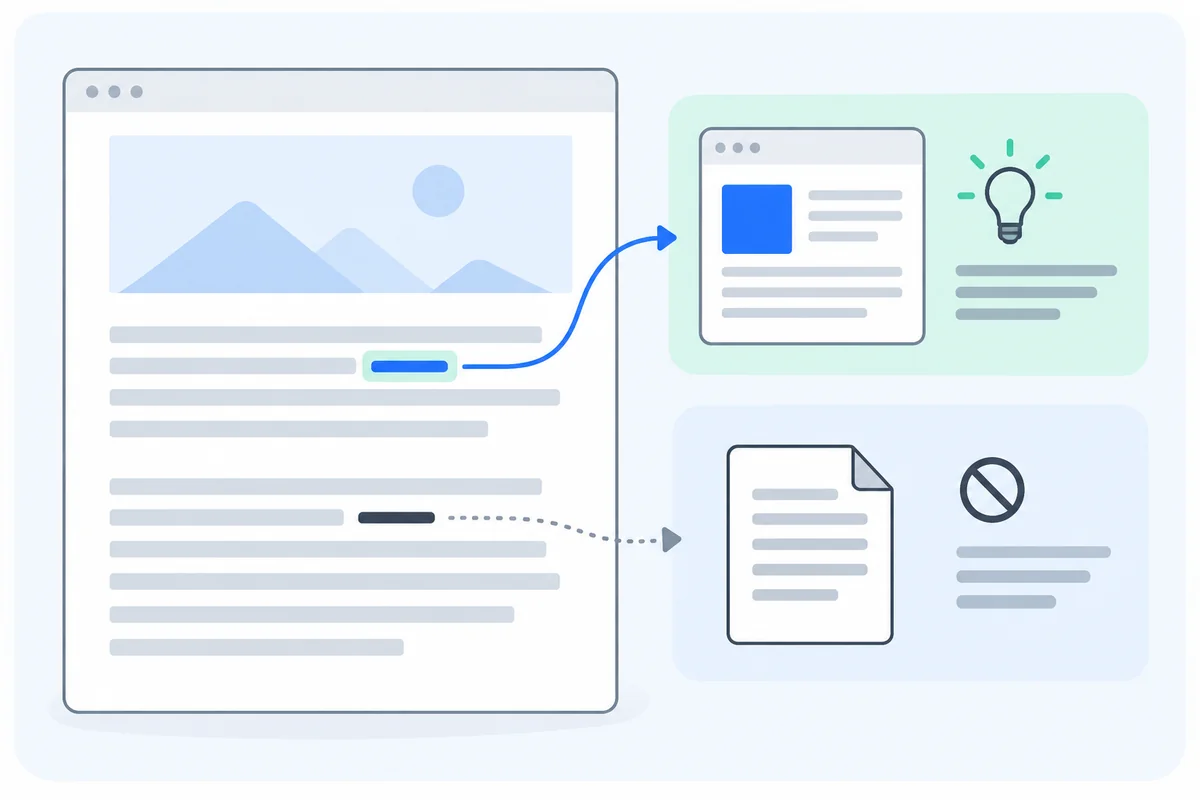
An unlinked brand mention is a page that names your brand without linking to a relevant page on your site. Reclamation means checking that mention and, when a link would help readers, asking the publisher whether they would be open to adding one. A mention is a starting point, not an entitlement to a backlink.
What you’ll learn
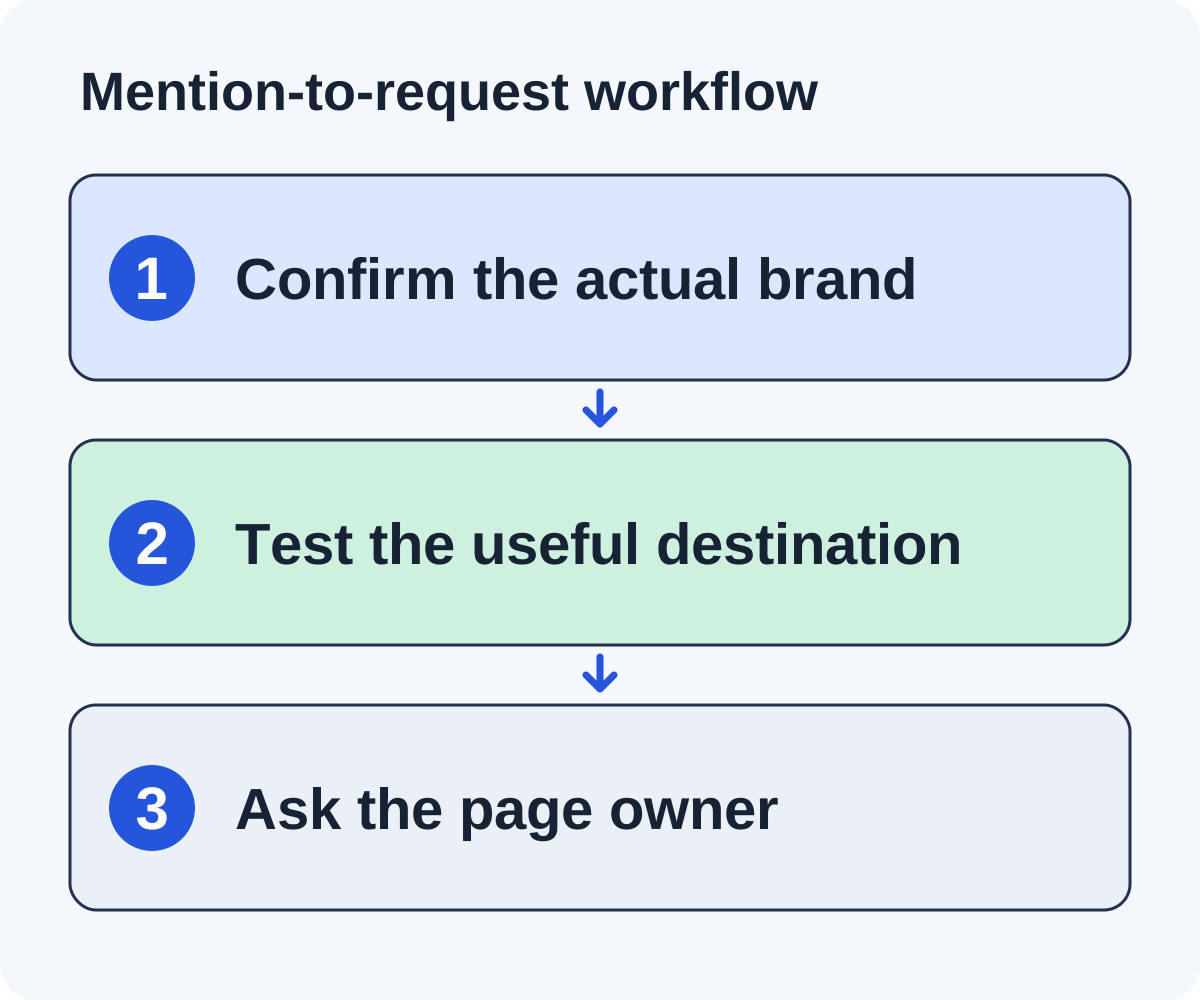
- Confirm that the mention is really about your brand.
- Check whether a link improves identification or access.
- Keep factual corrections separate from link requests.
Build a repeatable mention search
Start with a brand dictionary, not one query. Include your exact company name, distinctive product names, a named research report, and common spelling variants you have actually observed. Exclude generic words that describe many unrelated businesses. A short dictionary makes it possible to repeat the same investigation later and explain what the search covered.
For a fictional company called LedgerNest, the first query could be "LedgerNest" -site:ledgernest.example. A separate query for "LedgerNest MRR worksheet" narrows the task to mentions of the asset. Replace the fictional domain with your real domain. Google documents quotation marks, the site: operator, and the minus sign in its search refinement guidance. Search results are a discovery sample, not a complete mention inventory.
Keep a row for each referring page, even when several pages come from one publisher. Save the query that found it and the observation date. Visit the actual URL before classifying it; a snippet may summarize a page that has since changed. If your monitoring service supplies an alert, retain its original URL and then add your own page observation.
Use four initial buckets: genuine mention without a useful link, already linked, wrong identity, and uncertain. Investigation is the right state when the article is inaccessible or the named product could refer to another organization. Do not convert uncertainty into a confident pitch. On repeat searches, compare new pages and changed contexts against the existing records rather than contacting the same publisher again.
Record the date, section, surrounding context, and current destination if one exists. Provider discovery is useful evidence to investigate, not a substitute for the page check.
Decide whether a link would help
A link can help readers find the product, inspect a referenced study, or access a tool being discussed. It may add little when a passing mention is already clear and no further information is needed.
Use the destination that matches the mention. A discussion of a calculator should point to the calculator. A factual identification of the company may point to its homepage. Do not force every mention into the same commercial landing page.
Check the publisher’s policy and whether you have already contacted them. Some publications deliberately limit external links. A repeated request after a clear decline is not a new opportunity.
If the mention is critical or negative, assess any factual issue carefully. A request for a link should not become an attempt to erase the publisher’s independent view.
Triage three illustrative situations
| Mention | Decision | Reason |
|---|---|---|
| A tutorial names your public calculator but gives no access route | Consider a request | A direct link could let readers use the referenced tool. |
| A different business with the same name | Reject | The mention is not about your brand. |
| A brief company mention already linked in the references | No request needed | The useful destination is already provided. |
These examples are fictional. Apply the same reasoning to the live page rather than treating every exact-name match as a qualified lead.
Keep “no request needed” as a useful outcome. It prevents a later teammate from approaching a publisher about a link that already exists.
Work through a reclamation record
This is a fictional example, not a Linkade campaign result. A founder’s finance tutorial says, “LedgerNest has a worksheet for annual-plan adjustments.” The paragraph contains no link, and a review of the article’s references finds none. The worksheet is public and includes the calculation described. That creates a plausible reader benefit: someone reading the tutorial can reach the mentioned resource.
- Record the mention. Save the tutorial URL, the annual-plan heading, the exact sentence, and the date. Note that the mention names a resource rather than only the business.
- Test the destination. Open the worksheet from a fresh browser session. Check that the example is visible without an account and that it actually covers annual-plan adjustments. Use its stable URL rather than a tracking redirect.
- Find the appropriate editor. The tutorial’s author page or publication contact policy may identify the owner. Preserve the source supporting that choice; a contact-provider result alone does not establish ownership.
- Ask one question. Name the sentence and ask whether the editor would be open to linking it. Disclose that you are with the team that made it. Send the direct worksheet URL only after they say yes, and leave the link wording and final decision to the publisher.
Hi Jordan, thanks for mentioning our LedgerNest worksheet in the adjustments section of your annual-plan tutorial. I’m with the team that maintains it. Would you be open to linking that mention so readers can reach the example? If so, I can send the details.
After Jordan says yes, the reply gives the checked public URL of the worksheet. The first email carries no link. Neither message claims a prior relationship or tell the editor what anchor text to use. If the editor points out that the worksheet is gated, resolve that factual mismatch before asking again. If the editor declines, record the decision and stop. If the editor adds the reference, inspect the page; a reply saying “updated” is useful evidence to check, not final proof of the link.
Write a small, factual request
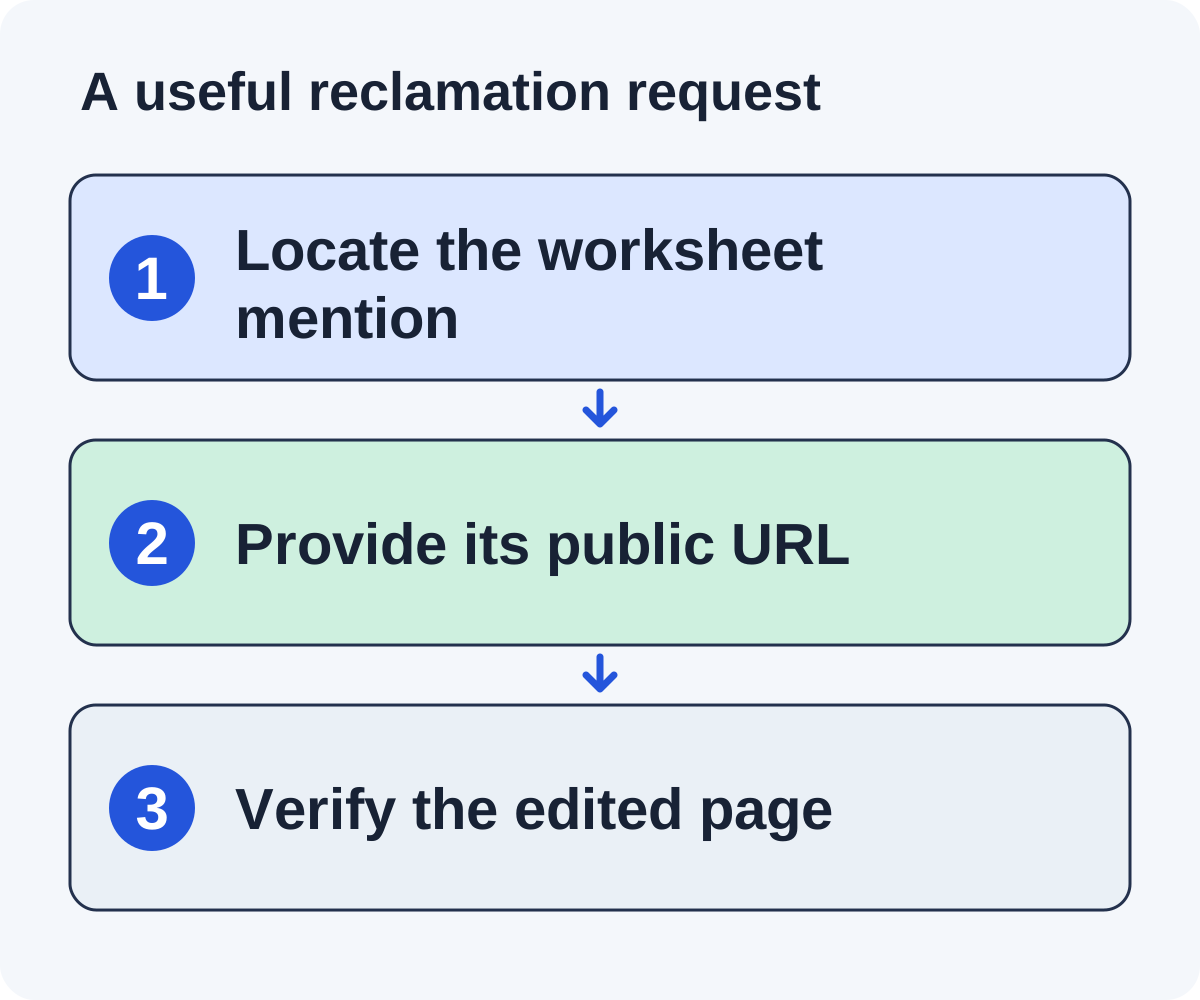
Hi Morgan, thanks for mentioning our MRR worksheet in the calculation section of your subscription-reporting guide. I’m with the team that made it. Would you be open to linking the mention so readers can reach the example? If so, I can send the details.
After Morgan says yes, the reply gives the direct worksheet URL at [real URL] and nothing more. The first email has no link and asks only whether Morgan is open to it.
This sample assumes a verified mention of a real worksheet. Replace the fictional details. Do not thank a publisher for using a product if the page only names it, and do not invent an existing relationship.
When there is also a factual error, describe it separately with a source. The editor should be able to accept a correction without feeling required to accept the link request.
Use a neutral destination and allow the publisher to choose wording. A reference should serve the page’s readers rather than fulfill a fixed anchor-text demand.
Handle difficult mentions without mixing requests
A factual correction and a link suggestion are separate decisions. Suppose a review says your worksheet supports multi-currency reporting when it does not. Send the checked product fact and a supporting source. Do not make correcting the sentence conditional on adding a backlink. If a direct resource link would also help, explain that benefit separately and let the editor accept either change.
A negative review can still identify the correct company. Read the criticism before proposing a link. A request should not imply that linking to your homepage resolves a dispute or that the publisher must change an independent opinion. If a factual claim requires legal or specialist review, route it through the appropriate person in your organization before contacting the publication.
A syndicated article can appear at several URLs. Check which publication controls the source and whether each copy can be edited. Preserve the canonical or attribution relationship you can observe, then avoid treating every copy as an independent author. One owner may make the change everywhere; another publisher may not control the original text.
A mention in an image, document, or social embed may have no editable HTML sentence. Explain the real location and available access route. Do not promise an easy text change when the publisher would need to replace an asset. If the page already offers a useful citation elsewhere, classify it as already linked even if your preferred sentence has no hyperlink.
Record what changed and what did not
After a positive response, inspect the page again. Record the link destination, context, attributes, and verified date. If only the factual wording changed, report that correction accurately instead of counting a backlink.
Keep unanswered, declined, corrected, already-linked, and newly-linked states separate. This makes the campaign understandable when provider alerts continue to return the same pages.
Recheck important destinations after a site migration. A reclaimed reference loses its practical usefulness if the suggested resource becomes inaccessible.
The contact guide helps identify the appropriate editor. Use the companion worksheet to keep mention verification and the reader benefit together before drafting a request.
Separate a useful source link from a homepage request
A fictional article names your team as the source of a public API migration survey. The mention is about the survey’s findings, so the most useful destination may be the report and its method, not your software homepage.
Confirm the sentence refers to the report you actually published. Check that the public page includes the cited finding, collection period, definitions, and limitations. If the article describes a broader conclusion than your data supports, prepare the factual correction separately from the link suggestion.
The first email can name the sentence and ask whether the publisher would be open to linking the report. After a yes, send the direct report URL and explain that readers can inspect the method there. Disclose your affiliation. Avoid using the mention as an opening to demand a commercial landing-page link or a preferred keyword anchor.
If the report has moved, test the current route and preserve a useful redirect. If its dataset is no longer accessible, describe what remains public instead of promising the original download. A source link helps only when it leads to the information the article discusses.
Record whether the publisher added a source citation, corrected a statement, did both, or declined. Those are distinct outcomes. A correction without a backlink is still a factual update and should not be misreported.
This second scenario uses the same verification method as brand-name reclamation but changes the destination decision. Match the link to the reader’s question: inspect a source, use a named tool, or identify a company.
Measure reclamation as a small editorial process
Count verified mentions, requests sent, substantive replies, factual corrections, and new live references separately. For a made-up review of 20 pages, imagine eight wrong-identity matches, five already-linked mentions, four useful unlinked mentions, and three uncertain pages. The outreach-ready set is four, not 20. Those numbers demonstrate classification only; they are not an expected success rate.
Keep a suppression record for a decline or request not to contact. Search alerts may return the same page next month, and a new teammate should be able to see why it is closed. An unanswered request can remain unanswered without an indefinite follow-up sequence. Use the follow-up guide for a bounded, reply-aware policy.
When a link is added, save the destination and surrounding description. A company homepage link and a worksheet reference may support different reader tasks. If the requested worksheet later moves, preserve a working route and update any misleading description you control.
Do all unlinked mentions deserve a request?
No. A passing name, a policy against external references, an existing useful citation, or a context that needs no additional information can make a request unnecessary. The reason to contact the publisher is a specific reader benefit you can explain, not simply ownership of the brand name.
Put it to work
Use the companion worksheet to apply the decisions in this guide to your own campaign.
Download the worksheet (.txt)Sources and further reading
See what is worth pitching for your site.
Linkade finds relevant pages and writes pitches from their content. Add your domain and inspect prospects before choosing a paid plan.
Start free